Quick Facts
Father of Chemistry": Oxygen, revolution, guillotine.
Conversation Starters
Life Journey
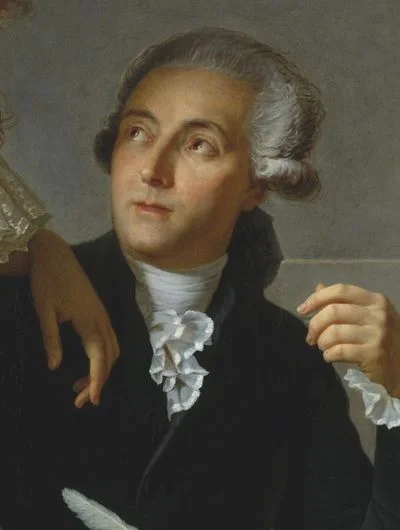
Antoine-Laurent de Lavoisier was born into a wealthy Parisian family. His father was a lawyer, and his mother died when he was five, leaving him a substantial inheritance that would later fund his scientific research.
Lavoisier enrolled at the prestigious College Mazarin, where he received an excellent education in the humanities, languages, and sciences. He showed exceptional aptitude for mathematics and natural philosophy.
While studying law to follow his father's profession, Lavoisier attended lectures in chemistry, botany, astronomy, and geology. His passion for science grew under the mentorship of prominent French scientists.
Lavoisier presented his first scientific paper to the Academy of Sciences on the composition of gypsum. This geological study demonstrated his meticulous experimental approach that would characterize his later work.
Lavoisier won a gold medal from the Academy of Sciences for his essay on the best method of lighting large cities. This practical application of science brought him recognition and funding.
At just 25, Lavoisier was elected to the prestigious French Academy of Sciences, the youngest member at the time. His election recognized his promising contributions to geology and chemistry.
Lavoisier purchased a share in the Ferme Generale, the tax collection company. While controversial, this position provided the substantial income needed to fund his expensive scientific equipment and experiments.
Lavoisier married 13-year-old Marie-Anne Pierrette Paulze, daughter of a fellow tax farmer. She became his invaluable scientific collaborator, translating works, illustrating his publications, and assisting in experiments.
Lavoisier began his revolutionary experiments on combustion, carefully measuring weight changes during burning. These experiments would eventually disprove the phlogiston theory and establish modern chemistry.
Lavoisier named the gas 'oxygen' (acid-maker) and correctly explained combustion as a reaction with this gas. This overturned the phlogiston theory that had dominated chemistry for a century.
Lavoisier demonstrated that matter is neither created nor destroyed in chemical reactions. This fundamental principle became a cornerstone of modern chemistry and physics.
Lavoisier became director of the French Gunpowder Commission, improving the quality and production of gunpowder. He moved into the Arsenal, which became his main laboratory.
Lavoisier published his masterwork 'Traite elementaire de chimie', which established modern chemical nomenclature and listed 33 elements. It is considered the first modern chemistry textbook.
Lavoisier conducted pioneering experiments on respiration with Armand Seguin, demonstrating that respiration is a form of slow combustion that consumes oxygen and produces carbon dioxide and heat.
During the Reign of Terror, Lavoisier was arrested along with other former tax farmers. Despite his scientific contributions, the Revolutionary Tribunal was unsympathetic to the wealthy elite.
Antoine Lavoisier was guillotined on May 8, 1794. The mathematician Lagrange lamented: 'It took them only an instant to cut off his head, but France may not produce another such head in a century.'