Quick Facts
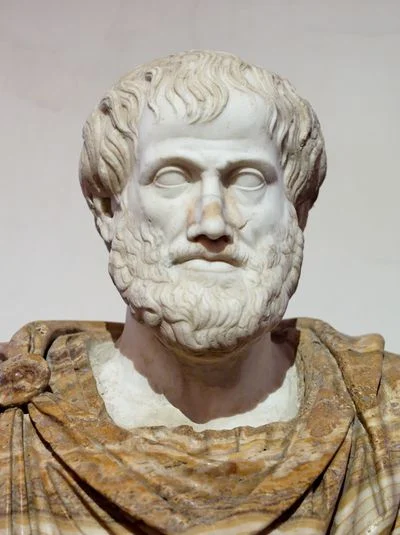
Father of Logic," Aristotle shaped thought, tutored Alexander, and founded Lyceum.
Conversation Starters
Life Journey
Aristotle was born in Stagira, a Greek colony in Macedonia. His father Nicomachus was the personal physician to King Amyntas III of Macedon, giving young Aristotle early exposure to the Macedonian court.
After losing both parents, Aristotle was raised by his guardian Proxenus of Atarneus. His early education included medicine and biology, subjects that would influence his later scientific investigations.
Aristotle traveled to Athens and enrolled in Platos Academy, the most prestigious intellectual institution of the Greek world. He would remain there for twenty years, becoming known as the mind of the school.
Aristotle established himself as one of the Academys foremost thinkers and began writing dialogues in the Platonic style. His brilliance was recognized by Plato himself, though they would later disagree on fundamental philosophical points.
Aristotle began formulating his philosophical differences with Plato, particularly regarding the Theory of Forms. He argued that forms exist within things rather than in a separate realm, famously declaring Plato is dear to me, but dearer still is truth.
Following Platos death, Aristotle left the Academy when Speusippus was chosen as successor. Some speculate he was passed over due to his non-Athenian status or his philosophical divergence from orthodox Platonism.
Aristotle spent several years conducting pioneering biological research, particularly marine biology at Lesbos. He dissected and classified hundreds of animal species, creating the foundation of systematic zoology.
King Philip II invited Aristotle to tutor his son Alexander. For three years, Aristotle educated the future conqueror in philosophy, medicine, and science at the Temple of the Nymphs at Mieza.
When Alexander became regent of Macedon, Aristotles tutorial role ended. He returned to his hometown, which had been destroyed by Philip II but was rebuilt partly in honor of Aristotle.
Aristotle returned to Athens and founded his own school, the Lyceum, in a grove sacred to Apollo. His habit of walking while lecturing gave his followers the name Peripatetics, meaning those who walk about.
At the Lyceum, Aristotle produced his most important treatises on logic, physics, metaphysics, ethics, politics, and biology. His works would become the foundation of Western scientific and philosophical thought.
Aristotle wrote the Organon, creating the discipline of formal logic including syllogistic reasoning. This system would dominate logical thought for over two thousand years until the development of modern logic.
Aristotle wrote his definitive work on ethics, exploring virtue, happiness, and the good life. Named after his son Nicomachus, it remains one of the most influential ethical treatises ever written.
Aristotle composed his treatise on political philosophy, analyzing 158 different Greek constitutions. He classified governments by who rules and whether they serve the common good or private interests.
When Alexander died, anti-Macedonian sentiment erupted in Athens. Charged with impiety, Aristotle fled to Chalcis, reportedly saying he would not let Athens sin twice against philosophy, referring to the execution of Socrates.
Aristotle died of natural causes, possibly a stomach ailment, just one year after leaving Athens. His will showed concern for his family, slaves, and the continuation of his school, which would thrive for centuries.