Quick Facts
Enlightened despot" Catherine: Expanded Russia, modernized, ruled longest.
Conversation Starters
Life Journey
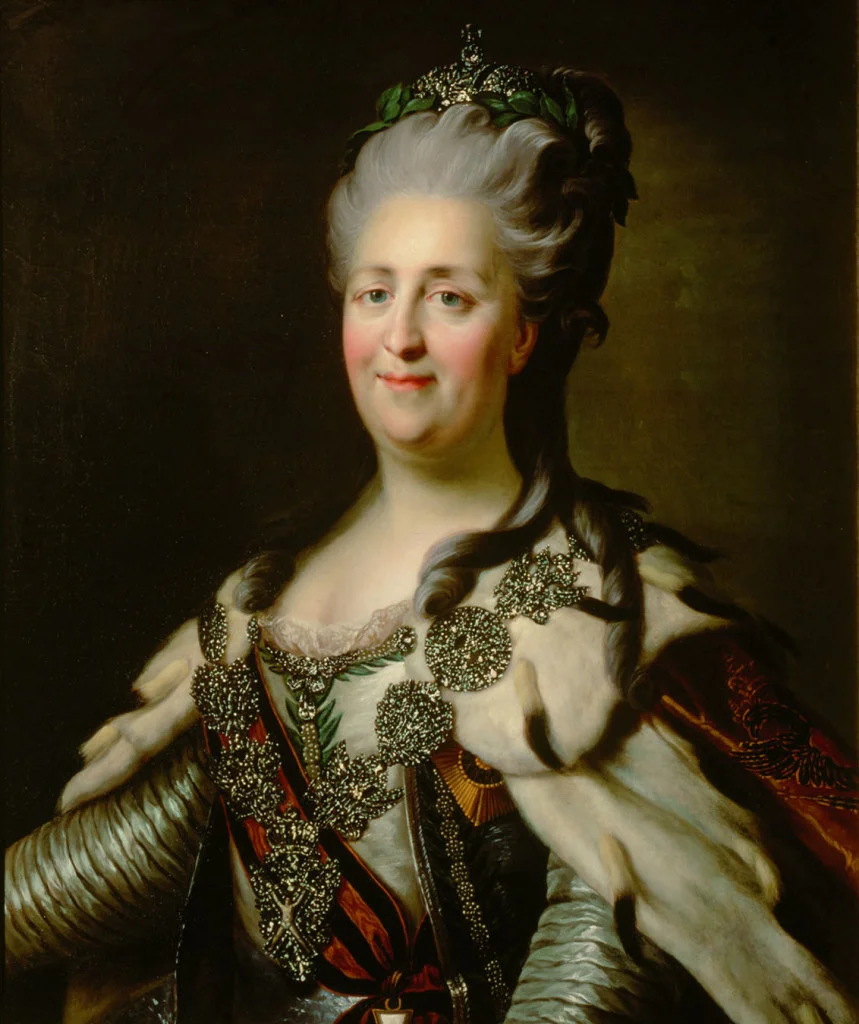
Catherine II, born Sophie Friederike Auguste von Anhalt-Zerbst, was the daughter of Christian August, Prince of Anhalt-Zerbst, and Johanna Elisabeth of Holstein-Gottorp.
At the age of 15, Sophie was engaged to Grand Duke Peter, heir to the Russian throne, as part of a political alliance between Prussia and Russia.
Sophie, now known as Catherine, married Grand Duke Peter, further solidifying the political alliance between Prussia and Russia.
After her marriage, Catherine officially became Grand Duchess of Russia and began to immerse herself in Russian culture and politics.
Catherine gave birth to her son, Paul, who would later become Emperor Paul I of Russia. The paternity of Paul was often questioned.
Catherine, with the support of the Imperial Guard, overthrew her husband, Emperor Peter III, in a coup and declared herself Empress of Russia.
Catherine began her series of enlightened reforms, including the establishment of the Legislative Commission to codify Russian laws and modernize the legal system.
Catherine reformed the Russian education system, founding the Smolny Institute for Noble Girls, the first state-financed higher education institution for women in Russia.
Catherine, along with Frederick II of Prussia and Maria Theresa of Austria, initiated the First Partition of Poland, expanding Russian territory.
Catherine successfully suppressed the rebellion led by Yemelyan Pugachev, a Cossack who claimed to be the late Emperor Peter III, securing her rule.
Catherine established the Free Economic Society to promote economic development and modernization in Russia, encouraging the use of scientific methods in agriculture and industry.
Catherine annexed the Crimean Peninsula from the Ottoman Empire, significantly expanding Russian territory and influence in the Black Sea region.
Catherine issued the Charter to the Nobility, which granted additional rights and privileges to the Russian nobility, strengthening their position in society.
Catherine published her 'Instructions for the Government of the Provinces,' which outlined her vision for administrative and judicial reforms in Russia.
Catherine II, known as Catherine the Great, died of a stroke in Saint Petersburg, leaving behind a legacy of expansion, reform, and cultural development in Russia.