Quick Facts
Gupta Empire soared under Chandragupta II: Art, science, and victory.
Conversation Starters
Life Journey
Chandragupta II was born around 350 CE into the Gupta dynasty, one of India's greatest imperial families. His father was Samudragupta, the great conqueror.
Young Chandragupta received extensive training in warfare, politics, and the arts. The Gupta court was a center of learning and cultural achievement.
Chandragupta married the Naga princess Kuberanaga, strengthening alliances with important regional powers. She bore him Kumaragupta I.
Following his father Samudragupta's death and his brother Ramagupta's brief reign, Chandragupta II became emperor, beginning the golden age of the Gupta dynasty.
According to tradition, Chandragupta married Dhruvadevi, who had been his brother's wife. The circumstances are unclear but became the subject of later legends.
Chandragupta consolidated the vast empire inherited from his father. He established efficient provincial administration and promoted trade.
Chandragupta married his daughter Prabhavatigupta to the Vakataka king, creating a powerful alliance that dominated central India.
Chandragupta conquered the Western Kshatrapas of Gujarat and Malwa, gaining access to vital ports on the western coast and their lucrative trade.
Chandragupta established Ujjain as a secondary capital after conquering the west. The city became a major center of trade, astronomy, and culture.
Under Chandragupta II, the Gupta Empire reached its cultural zenith. Literature, art, science, and philosophy flourished throughout the realm.
The Chinese Buddhist pilgrim Faxian visited India during Chandragupta's reign, leaving valuable descriptions of the peaceful and prosperous empire.
The great poet Kalidasa flourished under Chandragupta's patronage. His works including Shakuntala and Meghaduta represent the height of Sanskrit literature.
Chandragupta maintained diplomatic contacts with Sasanian Persia. Cultural exchange between the two empires enriched both civilizations.
The famous Iron Pillar, bearing an inscription praising Chandragupta II, was erected. Its rust-free iron demonstrates the advanced metallurgy of the era.
Under Chandragupta's patronage, Indian mathematicians and astronomers made groundbreaking discoveries, including early work on the concept of zero.
Chandragupta prepared his son Kumaragupta I for succession. The empire was at peace, prosperous, and culturally vibrant.
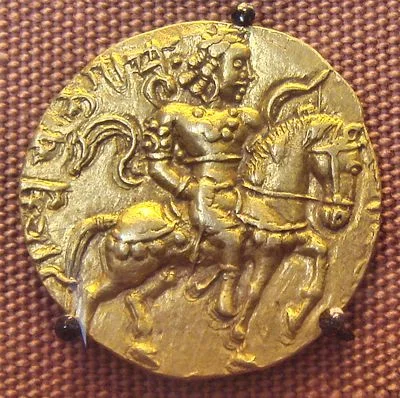
Chandragupta II earned the title 'Vikramaditya' (Sun of Valor), becoming legendary in Indian tradition. Stories of his court and the 'Nine Gems' of scholars became folklore.
Chandragupta II died around 415 CE after a reign of approximately 40 years. He left an empire at its peak, having presided over one of India's greatest cultural flowerings. His son Kumaragupta I continued the dynasty.