Quick Facts
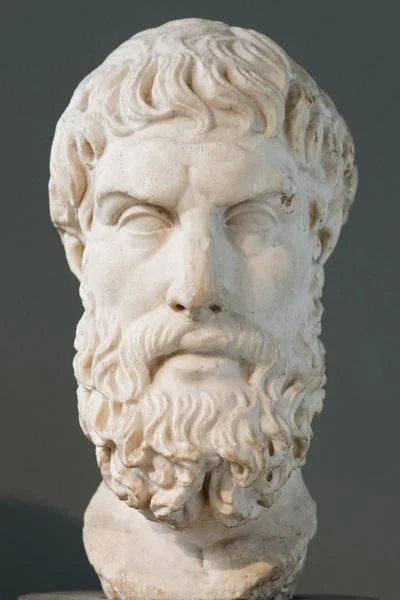
Pleasure through simplicity. Founded a philosophy of joy, friendship, and freedom from fear.
Conversation Starters
Life Journey
Epicurus was born to Athenian colonists on the island of Samos. His father Neocles was a schoolteacher, and young Epicurus showed early interest in philosophy when his teachers could not explain chaos in Hesiod's cosmogony.
Epicurus began studying philosophy with Pamphilus, a Platonist teacher. He rejected Platonism but learned the importance of systematic thinking that would characterize his own philosophical method.
Epicurus went to Athens for the two years of military training required of Athenian citizens. He arrived the same year Alexander the Great died, beginning a tumultuous period in Greek history.
When Perdiccas expelled the Athenian colonists from Samos, Epicurus's family relocated to Colophon in Asia Minor. He joined them after completing his military service, beginning years of wandering.
Epicurus studied atomism with Nausiphanes, a follower of Democritus. Though he later denied his teacher's influence, atomic theory became central to Epicurus's physics and metaphysics.
Epicurus established his first philosophical school on the island of Lesbos. Opposition from local philosophers, likely Aristotelians, forced him to leave after only a year.
Epicurus moved his school to Lampsacus on the Hellespont. Here he gathered the core disciples who would remain loyal throughout his life: Metrodorus, Polyaenus, and Hermarchus.
Epicurus purchased a garden in Athens and established his famous school, known simply as 'The Garden.' Unlike other philosophical schools, it admitted women and slaves as equals in the pursuit of wisdom.
Epicurus refined his atomic philosophy, arguing that the universe consists of atoms moving through void. He introduced the 'swerve' (clinamen) to explain free will and the creation of complex structures.
Epicurus developed his ethical philosophy, identifying pleasure (hedone) as the highest good. However, he defined pleasure as absence of pain (ataraxia) and mental tranquility, not hedonistic indulgence.
Epicurus composed his 'Principal Doctrines' (Kyriai Doxai), forty maxims summarizing his philosophy. These became the core teachings studied by his followers for centuries.
Epicurus wrote his famous Letter to Herodotus, summarizing his physics and cosmology. This and two other letters survive as the main sources for his teachings in his own words.
Epicurean communities spread throughout the Mediterranean world. Unlike Platonists or Stoics, Epicureans focused on friendship and peaceful withdrawal from public life rather than politics.
Epicurus developed a painful kidney condition that would plague his final years. Despite constant pain, he maintained his cheerful disposition and continued teaching, exemplifying his philosophy.
Epicurus died from kidney stones after two weeks of agonizing pain. His final letter expressed contentment, calling the day 'happy' as he recalled memories of philosophical conversations with friends. He freed his slaves in his will.