Quick Facts
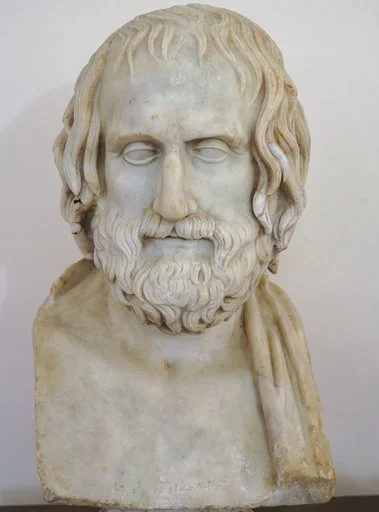
Euripides (c. 480–406 BC) was one of the three great tragedians of classical Athens, alongside Aeschylus and Sophocles. A revolutionary playwright who transformed Greek tragedy, he wrote approximately 92 plays, of which 18 survive complete—more than any other ancient dramatist. Unlike his predecessors who focused on heroic ideals, Euripides explored the psychology of ordinary people caught in extraordinary circumstances, giving voice to women, slaves, and outcasts. His innovative techniques included realistic dialogue, complex female protagonists like Medea and Phaedra, and questioning of traditional religious and social values. Often controversial in his lifetime, winning only four Dionysian festival competitions while alive, his works became the most frequently performed after his death. His influence on Western drama is immeasurable, pioneering psychological realism and social criticism that would not be seen again until modern theater.
Conversation Starters
Life Journey
Euripides was born on Salamis, possibly on the very day of the famous naval battle against Persia. His father Mnesarchus was reportedly a merchant, and his mother Cleito sold herbs. Despite later comic mockery of humble origins, his family was likely of good standing.
Young Euripides received education from the greatest minds of Athens. He studied under Anaxagoras, the natural philosopher, and was influenced by Protagoras and other Sophists. This philosophical training would profoundly shape his innovative approach to tragedy.
Euripides entered his first tragedy at the City Dionysia festival, competing against established playwrights. Though he did not win, his debut marked the beginning of a revolutionary career that would transform Greek drama.
After several attempts, Euripides won his first victory at the City Dionysia. This recognition, though rare in his lifetime, validated his unconventional approach to tragedy. He would win only four festivals while alive, compared to Sophocles' eighteen victories.
Euripides produced one of his early masterworks exploring the Medea mythology. This play showcased his interest in powerful female characters and the destructive nature of passion, themes that would define his career.
Euripides presented 'Medea,' now considered one of the greatest tragedies ever written. The play shocked audiences with its sympathetic portrayal of a woman who kills her own children. It won only third place, but became his most enduring work.
Euripides won first prize with 'Hippolytus,' a tragedy exploring destructive passion and the conflict between Aphrodite and Artemis. The play demonstrated his mastery of psychological complexity and earned rare critical acclaim during his lifetime.
The comic playwright Aristophanes began his famous mockery of Euripides in plays like 'The Acharnians.' Aristophanes criticized Euripides' portrayal of immoral characters and use of philosophical rhetoric, yet this attention proved his cultural significance.
During the brutal Peloponnesian War, Euripides staged 'The Trojan Women,' a devastating anti-war tragedy. Set after Troy's fall, the play showed the suffering of conquered women, serving as powerful commentary on Athenian imperial violence.
Euripides presented his version of the Electra story, radically different from Aeschylus and Sophocles. His Electra was not a noble heroine but a bitter, impoverished woman, demonstrating his commitment to psychological realism over heroic idealization.
Euripides produced innovative works including 'Helen,' which reimagined the famous myth claiming only a phantom went to Troy. This playful treatment of mythology showed his willingness to subvert traditional stories for philosophical and dramatic effect.
Euripides staged 'Phoenician Women,' an epic treatment of the Theban saga featuring elaborate spectacle and large cast. The play demonstrated his continued productivity and innovation even in his seventies.
Disillusioned with Athenian politics and public criticism, Euripides accepted an invitation from King Archelaus of Macedonia. He left Athens, never to return, finding patronage and peace at the Macedonian court for his final years.
In Macedonia, Euripides composed 'The Bacchae,' considered by many his greatest work. This powerful tragedy about Dionysus's revenge explored religious ecstasy, rationality, and the dangerous consequences of denying primal forces.
Euripides died in Macedonia before returning to Athens. Ancient sources tell colorful stories of being torn apart by dogs, but he likely died peacefully. His final plays—'The Bacchae,' 'Iphigenia at Aulis,' and 'Alcmaeon'—were produced posthumously in Athens, winning first prize.