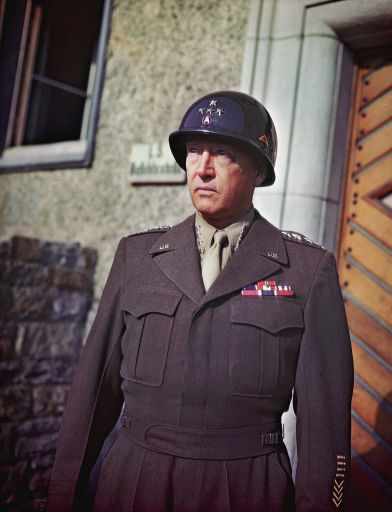
Quick Facts
A fiery American armored commander whose blunt discipline and daring maneuvers helped drive Allied victories in World War II.
Conversation Starters
Life Journey
Born to George S. Patton Jr. and Ruth Wilson Patton, he grew up on stories of Confederate service and American wars. The family’s martial tradition and Southern heritage shaped his early ambition and strict sense of honor.
After a short period at Virginia Military Institute, he secured admission to West Point and committed to an Army career. He battled academic difficulties, including dyslexia, relying on relentless practice and rigid self-discipline to progress.
Graduating from West Point, he was commissioned and assigned to the cavalry, embracing horsemanship and competitive training. He began developing the demanding leadership style that later defined his battlefield command and unit standards.
He married Beatrice Banning Ayer, whose family wealth and social connections helped stabilize his early career. Their long partnership endured frequent separations, and her letters and counsel remained important throughout his wartime commands.
Representing the United States, he placed highly in the modern pentathlon, an event combining riding, fencing, swimming, shooting, and running. The controversy around his pistol score only reinforced his obsession with performance, precision, and toughness.
As an aide to Brig. Gen. John J. Pershing, he gained field experience hunting Pancho Villa’s forces along the U.S.–Mexico border. He took part in one of the Army’s early motorized raids, foreshadowing his later enthusiasm for mechanization.
When the United States entered World War I, he deployed to Europe with Pershing’s staff and sought frontline command. He gravitated to tanks as the new decisive arm, seeing mechanized shock as the future of battlefield mobility and exploitation.
Commanding tank units in major AEF offensives, he pushed forward under fire to keep attacks moving and coordinate armor with infantry. During the Meuse-Argonne fighting he was wounded, earning a reputation for personal bravery and aggressive tempo.
In the interwar Army, he studied professional military science and argued for mobile warfare despite institutional resistance and tight budgets. He refined ideas about speed, combined arms, and discipline that later influenced U.S. armored formations.
As global tensions grew, he held key commands and trained troops with exacting standards, emphasizing marksmanship, maintenance, and rapid maneuver. Large-scale exercises helped validate mechanized concepts that the Army would soon apply in World War II.
After early American setbacks in North Africa, he was sent to impose order, raise discipline, and rebuild confidence under combat conditions. He tightened logistics and training while coordinating with British allies as the campaign turned toward Tunisia.
Commanding the U.S. Seventh Army, he drove across Sicily, racing to seize key ports and outmaneuver Axis defenses while coordinating with Allied commanders. The campaign showcased his operational speed, but also set the stage for damaging controversy.
After he struck two hospitalized soldiers suffering from battle fatigue, Dwight D. Eisenhower reprimanded him and removed him from frontline command. The episode sparked public outrage and forced the Army to confront combat stress and leadership limits.
To mislead German intelligence, Allied planners used him as a high-profile figurehead for the fictitious First U.S. Army Group, suggesting an attack at Pas-de-Calais. His reputation helped sell the ruse, supporting Operation Fortitude and the Normandy landings.
After Operation Cobra, he unleashed Third Army in a sweeping drive, exploiting German disarray with rapid armored thrusts and relentless pursuit. His headquarters emphasized tempo and logistics, while coordinating with Bradley and Eisenhower across the front.
When Germany launched its Ardennes offensive, he rapidly turned Third Army north in harsh winter conditions, a maneuver requiring meticulous staff work and fuel coordination. His forces helped relieve the encircled 101st Airborne at Bastogne and blunt the breakthrough.
Third Army crossed the Rhine and pushed deep into Germany, capturing cities and disrupting remaining Wehrmacht formations. His troops encountered concentration camps, confronting the realities of Nazi crimes and the urgent humanitarian aftermath of the war.
After Germany’s surrender, he oversaw occupation duties in Bavaria under U.S. command structures and faced political scrutiny for blunt remarks about former Nazis. Tensions with superiors and public controversy led to his reassignment away from top occupation authority.
He was severely injured when his staff car collided with an Army truck, suffering spinal trauma that left him paralyzed. He died days later in a U.S. Army hospital, and was buried with wartime dead he had led across Europe.