Quick Facts
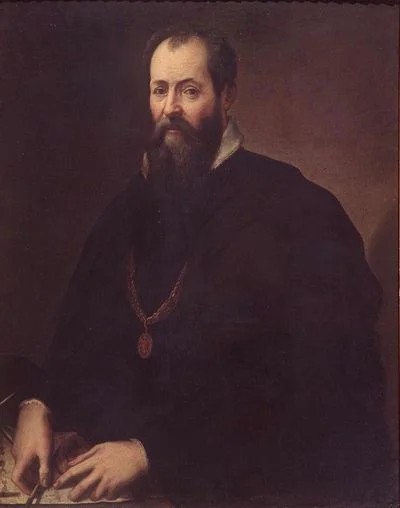
Lives" author: Vasari chronicled Renaissance artists, shaping art history forever.
Conversation Starters
Life Journey
Giorgio Vasari was born to Antonio and Luzzina Vasari in Arezzo, a city in the Republic of Florence.
Vasari starts his artistic training under the guidance of Guglielmo da Marsiglia, a prominent goldsmith and painter in Arezzo.
Vasari travels to Florence to further his studies under the patronage of Cardinal Silvio Passerini, where he is exposed to the works of leading artists.
Vasari accompanies Cardinal Passerini to Rome, where he studies the masterpieces of Michelangelo and other Renaissance artists.
Vasari is appointed court painter for Duke Cosimo I de' Medici in Florence, marking the beginning of a long and fruitful collaboration.
Vasari begins work on the frescoes in the Hall of the Five Hundred in the Palazzo Vecchio, one of his most significant artistic achievements.
Vasari designs the Uffizi palace, a monumental building that will later house one of the world's most famous art galleries.
Vasari publishes the first edition of his famous biographies, which becomes a foundational text in the history of art.
Vasari starts constructing the Vasari Corridor, a raised passageway connecting the Palazzo Vecchio to the Pitti Palace.
Vasari designs the Fountain of Neptune for the Piazza della Signoria, a significant public work in Florence.
Vasari co-founds the Accademia dell'Arte del Disegno in Florence, the first academy of fine arts in Europe.
Vasari publishes a revised and expanded edition of his 'Lives of the Artists,' including new biographies and additional details.
Vasari designs the chapel of the Ricci family in the Basilica of Santa Maria Novella, showcasing his architectural and artistic skills.
Vasari completes the fresco of the Last Supper for the Church of Santa Croce, one of his final major works.
Giorgio Vasari dies in Florence, leaving behind a rich legacy in art, architecture, and art history.