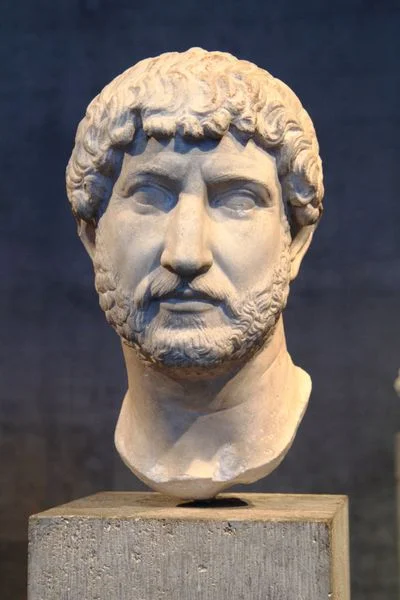
Quick Facts
Built the Wall. Traveled every province. Philosopher-emperor who knew Rome's limits.
Conversation Starters
Life Journey
Hadrian was born to Publius Aelius Hadrianus Afer and Domitia Paulina. He was a member of the gens Aelia.
Hadrian's parents died, and he became the ward of his father's cousin, the future Emperor Trajan, who would greatly influence his life.
Hadrian began his military career as a tribune in the Legio II Adiutrix, marking the start of his rise through the ranks.
Hadrian married his second cousin, Vibia Sabina, as part of a political alliance arranged by Trajan and his wife, Plotina.
Hadrian was appointed quaestor, a key administrative and financial role, further cementing his position in the Roman political hierarchy.
Hadrian was promoted to the rank of praetor, a significant step in his political career, overseeing judicial and administrative duties.
Hadrian was appointed governor of Pannonia Inferior, a region known for its strategic military importance on the Danube frontier.
Following the death of Trajan, Hadrian was declared Emperor by the Senate, marking the beginning of his 21-year reign.
Hadrian embarked on a series of extensive travels, visiting provinces to assess their conditions and strengthen the Empire's defenses.
Hadrian ordered the construction of Hadrian's Wall in northern Britain to mark the northern boundary of the Empire and defend against invasions.
Hadrian completed the construction of the Pantheon, a temple dedicated to all the gods, which remains a significant architectural achievement.
Hadrian visited Egypt and Greece, promoting cultural exchange and reinforcing the Empire's cultural ties with these regions.
Hadrian adopted Antoninus Pius as his heir, ensuring a smooth transition of power and the continuation of the Nerva–Antonine dynasty.
The Bar Kokhba Revolt erupted in Judea, and Hadrian responded by sending forces to suppress the rebellion, which lasted until 135.
Hadrian died in Baiae, Italy, after a long and successful reign. He was succeeded by Antoninus Pius, as he had arranged.