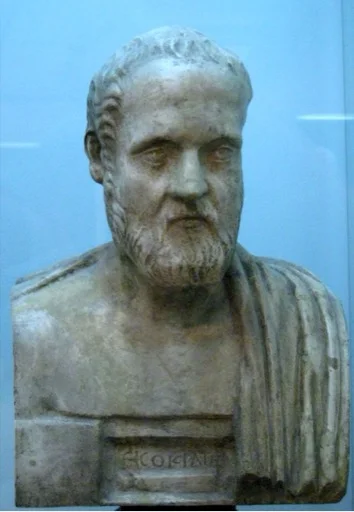
Quick Facts
Influential rhetorician and educator who championed pan-Hellenic unity and shaped classical Greek oratory.
Conversation Starters
Life Journey
Isocrates was born into a wealthy Athenian family. His father Theodorus manufactured flutes, a trade that brought considerable prosperity. The young Isocrates grew up during the golden age of Periclean Athens, surrounded by the finest cultural achievements of the ancient world.
Isocrates studied under the famous Sophists Prodicus of Ceos and Gorgias of Leontini. These masters taught him the art of rhetoric and persuasion. He also studied with Socrates, though he would later chart a different philosophical course than his teacher.
The Peloponnesian War devastated Athens and destroyed his family's wealth. His father's flute-making business collapsed, leaving Isocrates impoverished. This catastrophe would shape his entire career, forcing him to find new means of supporting himself.
Unable to speak publicly due to his weak voice and shy temperament, Isocrates began writing speeches for others to deliver in court. His logographic work honed his prose style, though he later expressed shame about this commercial period of his career.
Isocrates established his famous school of rhetoric near the Lyceum in Athens. Charging 1,000 drachmas per student—a substantial sum—he attracted pupils from across the Greek world. His school would rival Plato's Academy as Athens' premier institution of higher learning.
Isocrates published his manifesto distinguishing his educational philosophy from both the Sophists and Plato. He argued that rhetoric should train leaders for practical wisdom, not mere verbal tricks or abstract contemplation. This work established his school's reputation.
After ten years of meticulous composition, Isocrates published his masterpiece calling for Greek unity against Persia. This speech advocating Panhellenic cooperation under Athenian leadership became the most famous rhetorical work of its age and influenced Greek politics for decades.
His student Timotheus, son of the famous general Conon, won major naval victories for Athens. Isocrates took pride in having trained leaders who combined eloquence with practical achievement, vindicating his belief that rhetoric should serve the state.
The competition between Isocrates' school and Plato's Academy intensified. While Plato taught abstract philosophy and mathematics, Isocrates emphasized practical rhetoric and political wisdom. Both men respected each other yet fundamentally disagreed about education's purpose.
At age 82, Isocrates published this autobiographical defense of his life and teaching. Modeled on Socrates' Apology, it presented his educational philosophy and responded to critics who called him merely a teacher of tricks. The work stands as his intellectual testament.
Over decades, Isocrates trained roughly one hundred students who went on to prominence throughout the Greek world. Historians, orators, generals, and statesmen all claimed his instruction. His influence spread far beyond Athens through these educated men.
Isocrates sent his famous epistle to Philip II of Macedon, urging the king to unite Greece and lead a campaign against Persia. This letter reflected his evolving belief that Macedonian power might achieve what Athens could not. His advice would prove prophetic.
Isocrates published his final major work, again urging Philip to unite the Greeks. At ninety years old, he remained intellectually active, still refining his prose and advocating for Panhellenic unity. His vision of Greek cultural unity transcending city-state rivalries was decades ahead of its time.
Isocrates witnessed Athens' declining power with growing despair. Demosthenes led resistance against Macedon while Isocrates had hoped for cooperation. The old teacher saw his city torn between resistance and accommodation, his dream of willing Greek unity fading.
Days after Philip defeated the Greeks at Chaeronea, Isocrates chose to end his life by refusing food. He died at 98, unable to bear seeing Greek freedom destroyed by force rather than united by culture. His death embodied the tragedy of his vision: unity achieved through conquest rather than education.