Quick Facts
A fearless Czech reformer who challenged church corruption, preached in the vernacular, and died a martyr at Constance.
Conversation Starters
Life Journey
Born in the small market town of Husinec in southern Bohemia, he took the name "Hus" from his birthplace. Raised in a late-medieval society shaped by parish life and royal politics, he sought education as a path to advancement.
He traveled to Prague to study at the University of Prague, then one of Central Europe’s leading schools. In the city’s intense intellectual climate, he encountered debates over scholastic theology, church wealth, and pastoral reform.
He completed the arts curriculum at the University of Prague, building a foundation in logic, philosophy, and rhetoric. The university’s "nations" system and rivalries between Czech and German masters would later shape his reform politics.
After earning a Master of Arts, he joined the university as a teacher, lecturing and disputing in the scholastic style. His reputation for moral seriousness grew as he contrasted academic learning with the clergy’s worldly behavior.
He was ordained to the priesthood and increasingly focused on preaching and pastoral care rather than court patronage. Bohemia’s church, intertwined with royal power, provided both opportunities and sharp conflicts for a reform-minded cleric.
He became preacher at Bethlehem Chapel, a major Prague pulpit dedicated to sermons in the Czech language. There he urged ethical reform, attacked simony, and called clerics to apostolic poverty, drawing large lay crowds and elite attention.
University authorities condemned a set of propositions associated with the English theologian John Wycliffe, whose writings circulated in Prague. Hus continued to value Wycliffe’s critique of clerical vice, even as opponents equated him with heresy.
During the Western Schism, rival popes claimed authority and pressured Bohemia to choose sides, escalating local tensions. Hus’s circle argued that moral integrity mattered more than political obedience, alarming church officials seeking uniform loyalty.
King Wenceslaus IV issued the Decree of Kutna Hora, giving Czech masters greater voting power at the University of Prague. The change strengthened Hus’s allies but provoked an exodus of many German masters, deepening ethnic and religious polarization.
He was elected rector, gaining a prominent platform within Bohemia’s most influential intellectual institution. His leadership linked academic reform to church criticism, turning university debates into a wider public confrontation with ecclesiastical authority.
Archbishop Zbynek Zajic ordered the burning of Wycliffe’s writings, staging a dramatic assertion of orthodoxy. Hus protested the action as unjust and anti-intellectual, and the dispute hardened lines between reform preachers and church administration.
As conflicts over doctrine and authority intensified, ecclesiastical sanctions were imposed that isolated him within official church structures. He insisted that obedience to Christ and Scripture outweighed corrupt command, a stance that made compromise harder.
When indulgences were promoted in Prague to fund Pope John XXIII’s military campaigns, Hus denounced the practice as spiritual fraud. Public unrest followed, and his break with key patrons widened as authorities punished critics and silenced protests.
To reduce turmoil in Prague, he withdrew to rural castles under noble protection and preached to villagers and local gentry. From exile he wrote major defenses such as "De Ecclesia," arguing the true Church is the community of the faithful under Christ.
He journeyed to Constance to answer charges before the Council, relying on a safe-conduct associated with King Sigismund. The Council aimed to end the Schism and suppress dissent, and Hus’s case became a test of conciliar authority versus reform claims.
Soon after reaching Constance, he was arrested and held in harsh conditions, limiting access to supporters and legal defense. His imprisonment signaled the Council’s determination to control proceedings, even when political promises of protection were contested.
At public hearings, he was pressed to renounce teachings alleged to come from Wycliffe and his own sermons at Bethlehem Chapel. He appealed to Scripture and conscience, arguing for correction by evidence rather than forced recantation under threat.
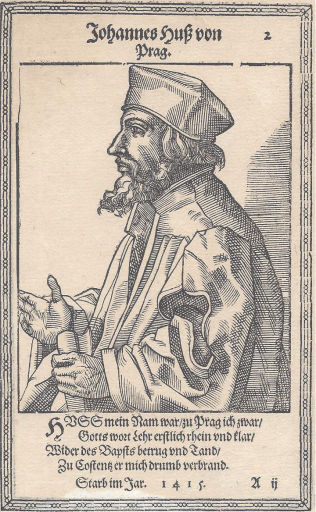
Condemned as a heretic, he was burned outside Constance on 6 July 1415, with his ashes cast into the Rhine to prevent veneration. News of the execution inflamed Bohemia, helping spark the Hussite movement and decades of religious war.