Quick Facts
Napoleon's Empress Joséphine: Grace, power, and lasting influence on French society.
Conversation Starters
Life Journey
Josephine de Beauharnais was born Marie Josèphe Rose Tascher de La Pagerie on the island of Martinique in the French West Indies.
Josephine began her formal education at a convent school in Martinique, where she received a strict and religious upbringing.
At the age of 16, Josephine married Alexandre de Beauharnais, a wealthy aristocrat, and moved to Paris, beginning her life in high society.
Josephine gave birth to her first child, Eugène de Beauharnais, in Paris, solidifying her position in the aristocratic circle.
Josephine's second child, Hortense de Beauharnais, was born, further expanding her family and social network.
Josephine and her husband Alexandre were imprisoned during the Reign of Terror, a period of extreme political upheaval in France. Alexandre was executed, but Josephine was released.
Josephine met Napoleon Bonaparte, a rising military figure, and began a romantic relationship that would change her life dramatically.
Josephine married Napoleon Bonaparte in a civil ceremony, marking the beginning of her ascent to the highest echelons of French society.
Napoleon Bonaparte became the First Consul of France, and Josephine, as his wife, became a prominent figure in French politics and high society.
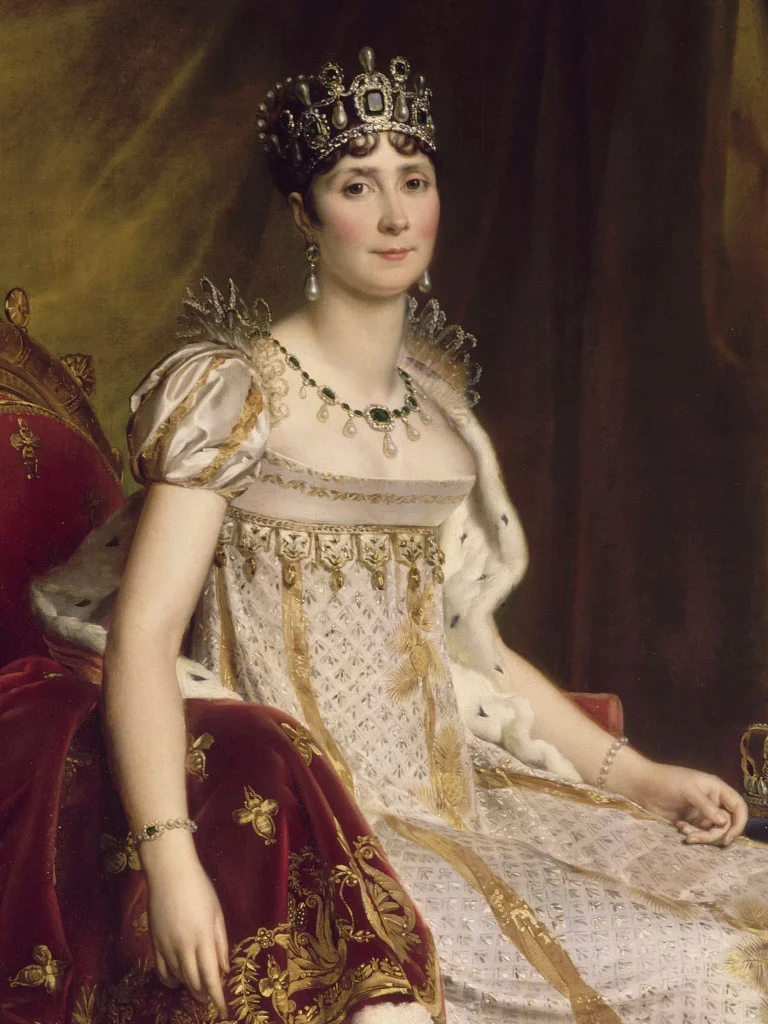
Josephine was crowned Empress of the French alongside Napoleon in a grand ceremony at Notre-Dame Cathedral, symbolizing the height of her influence and status.
As Empress, Josephine played a significant role in shaping French fashion, art, and culture, hosting lavish events and setting trends that were widely emulated.
Napoleon and Josephine were divorced by mutual consent, primarily due to her inability to bear him an heir, marking a significant personal and political shift.
After her divorce, Josephine retired to her beloved Château de Malmaison, where she maintained her social influence and continued to cultivate her gardens and collections.
Despite her divorce, Josephine remained a respected figure and continued to influence French society through her connections and social gatherings at Malmaison.
Josephine de Beauharnais died at her beloved Château de Malmaison, leaving behind a legacy as a significant figure in French history and high society.