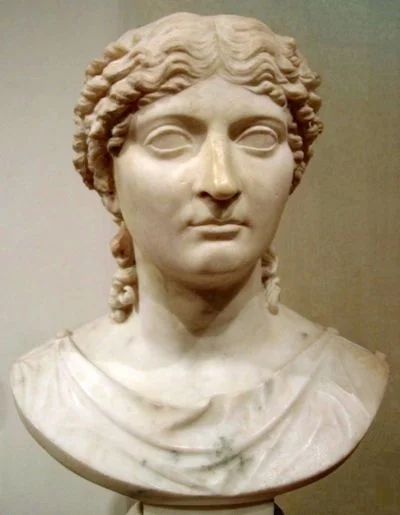
Quick Facts
Agrippina: Mother of Nero, power behind throne, Claudius met his end.
Conversation Starters
Life Journey
Julia Agrippina, known as Agrippina the Younger, was born to Germanicus and Agrippina the Elder in Colonia Claudia Ara Agrippinensium (modern-day Cologne, Germany).
Agrippina and her siblings were brought to Rome after her father Germanicus' death. She was raised in the imperial household under the watchful eye of her grandmother, Livia Drusilla.
At the age of 13, Agrippina was married to Gnaeus Domitius Ahenobarbus, a prominent Roman nobleman, solidifying political alliances and securing her social status.
Agrippina gave birth to her only son, Lucius Domitius Ahenobarbus, who would later become the Emperor Nero. This event marked the beginning of her influence in Roman politics.
Agrippina's mother, Agrippina the Elder, was exiled by Emperor Tiberius, an event that deeply affected Agrippina and shaped her political ambitions and resilience.
Agrippina's cousin Caligula became Emperor, and she was recalled from exile. Her status and influence began to grow as she navigated the complex imperial court.
Agrippina was married to Marcus Junius Silanus, a wealthy and influential Roman senator, further expanding her political network and social standing.
Caligula was assassinated, and Claudius, Agrippina's uncle, became Emperor. Agrippina moved closer to the center of power and began to influence imperial decisions.
Agrippina married Gaius Sallustius Crispus Passienus, a wealthy and influential senator, further solidifying her position and expanding her resources.
Passienus died, and Agrippina returned to Claudius' court. She began to actively plot to secure her son Nero's position as heir to the throne.
Agrippina married her uncle, Emperor Claudius, becoming Empress and gaining significant influence over imperial affairs. This marriage was a pivotal moment in her political career.
Claudius adopted Agrippina's son Nero, making him a legitimate heir to the throne. This event was crucial in Agrippina's plan to ensure Nero's succession.
Agrippina is believed to have orchestrated the assassination of Claudius, possibly through poisoning, to secure Nero's succession as Emperor. Nero became Emperor at the age of 17.
Nero became Emperor, and Agrippina initially held significant influence over his reign. However, their relationship soon became strained as Nero sought to assert his independence.
Nero, fearing Agrippina's influence and potential plots against him, ordered her assassination. She was killed at her villa in Misenum, marking the end of her powerful and tumultuous life.