Quick Facts
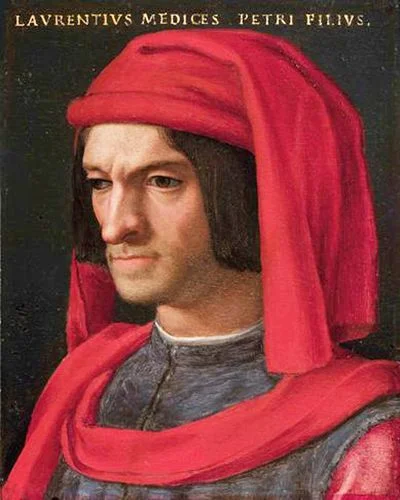
Magnifico" Lorenzo: Florence's ruler, Renaissance art's champion, power, and poetry.
Conversation Starters
Life Journey
Lorenzo de' Medici was born into the wealthiest and most powerful family in Florence. His grandfather Cosimo had established the Medici bank as Europe's most successful financial institution, and young Lorenzo was groomed from birth for leadership.
Lorenzo began his education under leading humanist scholars, studying Latin, Greek, philosophy, and poetry. His teachers included Gentile de' Becchi and later Marsilio Ficino, who would become his lifelong intellectual companion.
At just ten years old, Lorenzo was sent to Milan to represent Florence at the wedding of the Duke's son. This early diplomatic experience demonstrated the Medici practice of preparing heirs for political leadership from childhood.
Cosimo de' Medici, the patriarch who had built the family's fortune and political dominance, died. Power passed to Lorenzo's father Piero, though Lorenzo increasingly participated in family affairs and diplomatic missions.
Lorenzo was betrothed to Clarice Orsini, a Roman noblewoman. This strategic marriage allied the Medici with Roman aristocracy, though Lorenzo's true romantic passion was for Lucrezia Donati, who inspired much of his poetry.
Upon his father Piero's death, the twenty-year-old Lorenzo assumed leadership of Florence. Though the republic maintained its democratic forms, Lorenzo skillfully controlled the city through patronage, influence, and strategic marriages.
Lorenzo married Clarice Orsini in a lavish ceremony that displayed Medici wealth and power. Despite his poetic devotion to others, Lorenzo was a faithful husband, and Clarice bore him ten children.
Lorenzo formally established the Platonic Academy at Careggi, gathering the greatest minds of the Renaissance. Under Marsilio Ficino's leadership, the Academy translated Plato and developed Neoplatonist philosophy that influenced European thought.
Lorenzo commissioned Andrea del Verrocchio to create the bronze David, now in the Bargello. This was one of countless artistic commissions that made Lorenzo the Renaissance's greatest patron, supporting artists including Botticelli and the young Leonardo da Vinci.
During High Mass at the Florence Cathedral, the Pazzi family and their allies attacked Lorenzo and his brother Giuliano. Giuliano was killed, but Lorenzo escaped with wounds. He orchestrated brutal revenge, executing conspirators and crushing the Pazzi family.
After Pope Sixtus IV allied with Naples against Florence following the Pazzi affair, Lorenzo made the daring decision to travel alone to Naples. His personal diplomacy secured peace and enhanced his reputation as a statesman.
Lorenzo sent a delegation of Florence's finest artists to Rome to decorate the Sistine Chapel for Pope Sixtus IV. Artists including Botticelli, Ghirlandaio, and Perugino created masterpieces that reconciled Florence with the papacy.
Lorenzo secured an alliance with the new Pope Innocent VIII, arranging for his son Giovanni to become a cardinal at just thirteen. This strategic coup ensured Medici influence in Rome and eventually led to Giovanni becoming Pope Leo X.
Lorenzo welcomed the young philosopher Pico della Mirandola to Florence after his 900 Theses were condemned by Rome. Lorenzo's protection of controversial thinkers made Florence the intellectual capital of Renaissance Europe.
Clarice Orsini died after years of ill health. Though their marriage was arranged for political purposes, Lorenzo mourned her sincerely and never remarried, focusing on his children's futures and Florence's governance.
Lorenzo noticed the teenage Michelangelo Buonarroti's extraordinary talent and brought him into the Medici household. He treated Michelangelo as a son, providing education and access to the Medici collection of ancient sculptures.
Lorenzo's health deteriorated significantly, suffering from the hereditary gout that had afflicted the Medici. Despite his illness, he continued governing Florence and patronizing the arts until his final days.
Lorenzo il Magnifico died at his villa at Careggi, surrounded by Poliziano, Pico della Mirandola, and other scholars. His death marked the end of Florence's golden age and the beginning of the Italian Wars that would devastate the peninsula.