Quick Facts
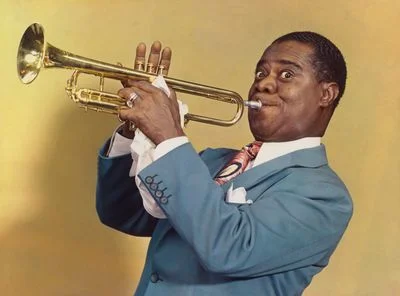
Satchmo": Jazz icon blew his horn, world sang along.
Conversation Starters
Life Journey
Louis Armstrong was born into extreme poverty in the Back o' Town neighborhood of New Orleans. Raised largely by his grandmother and mother, he grew up surrounded by the vibrant musical culture of the city's streets and honky-tonks.
Louis began working for a Jewish immigrant family, the Karnofskys, who ran a junk hauling business. They treated him kindly, lending him money to buy his first cornet. He wore a Star of David for the rest of his life in their honor.
After firing a pistol into the air on New Year's Eve, young Louis was arrested and sent to the Colored Waif's Home for Boys. This proved transformative as he received formal music instruction and led the institution's brass band.
Louis replaced his mentor King Oliver in Kid Ory's band, one of the top bands in New Orleans. He played on riverboats, developing his skills and reputation among musicians who recognized his extraordinary talent.
King Oliver invited Louis to join his Creole Jazz Band in Chicago. This move north was pivotal, placing Armstrong at the center of the burgeoning jazz scene and beginning his rise to national prominence.
Louis married pianist Lil Hardin, who encouraged his independence and ambition. She pushed him to leave King Oliver's shadow and pursue his own career as a bandleader, shaping his professional trajectory.
Louis formed his legendary recording groups, the Hot Five and Hot Seven. Their recordings between 1925-1928 revolutionized jazz, showcasing Armstrong's virtuosic trumpet playing and pioneering scat singing.
Louis recorded 'West End Blues,' widely considered one of the most important recordings in jazz history. Its opening cadenza demonstrated unprecedented technical virtuosity and emotional depth, influencing generations of musicians.
Louis appeared in his first film and began regular radio broadcasts. He became one of the first African American entertainers to achieve widespread popularity with white audiences, breaking significant racial barriers.
Louis had a major role in the Bing Crosby film 'Pennies from Heaven,' one of his most prominent film appearances. His charismatic screen presence helped establish him as an international entertainment icon.
Louis and his fourth wife Lucille purchased a home in Corona, Queens, where he would live for the rest of his life. Despite his fame and wealth, he chose to remain in this modest working-class neighborhood.
Louis formed the Louis Armstrong All Stars, a small combo that would be his primary performing group for the rest of his career. This shift from big bands allowed more intimate performances showcasing his musicianship.
Louis embarked on State Department-sponsored tours as a 'Goodwill Ambassador,' performing throughout Africa, Europe, and Asia. His cultural diplomacy earned him the nickname 'Ambassador Satch' and spread jazz worldwide.
Louis publicly criticized President Eisenhower's handling of the Little Rock school desegregation crisis, calling the government 'two-faced.' This rare political statement risked his career but earned respect for his courage.
Louis's recording of 'Hello, Dolly!' knocked The Beatles from the #1 position, making him the oldest person to achieve a #1 hit at age 62. The song revitalized his career and introduced him to new generations.
Louis recorded 'What a Wonderful World,' which became one of his most beloved songs. Though initially unsuccessful in America, it became an international hit and enduring testament to his optimistic spirit.
Despite declining health and heart problems, Louis continued performing until his final concert. His dedication to entertaining audiences remained undiminished even as his physical abilities waned.
Louis Armstrong died peacefully in his sleep at his home in Corona, Queens. The world mourned the loss of 'Satchmo,' whose revolutionary artistry and joyful spirit had fundamentally transformed American music and touched millions of lives worldwide.