Kurzinfo
"Frieden in unserer Zeit". Beschwichtiger, das Muenchener Abkommen kaufte Zeit — oder verlor sie.
Gesprächseinstiege
Lebensweg
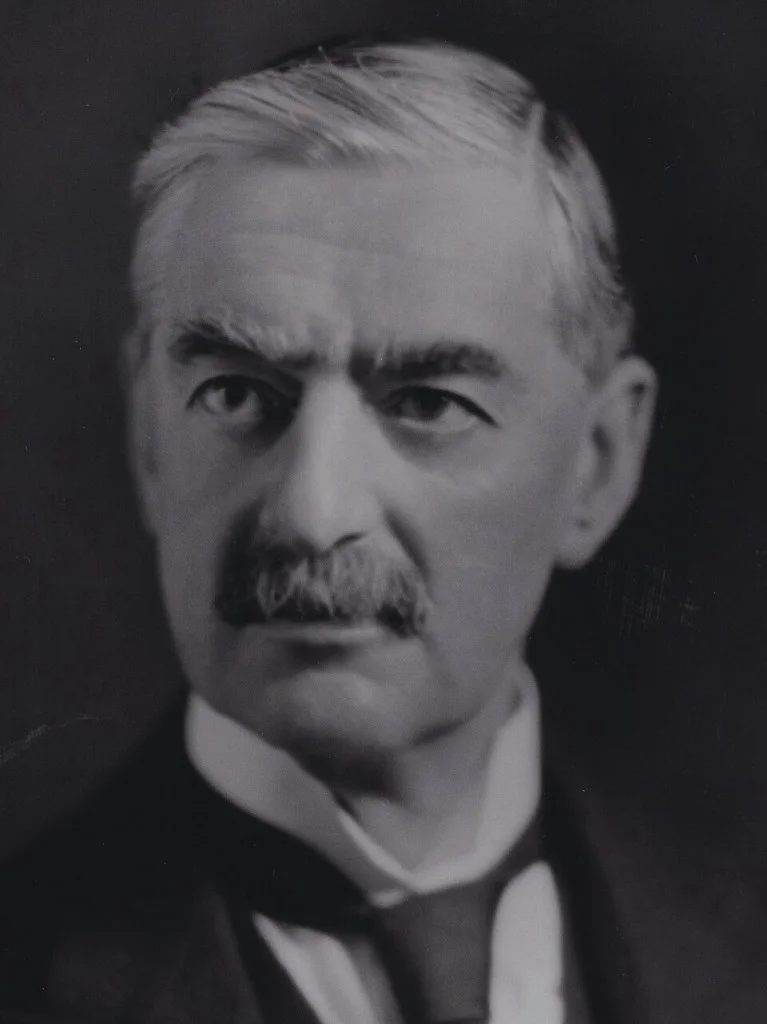
Neville Chamberlain wurde als Sohn von Joseph und Harriet Chamberlain in Birmingham, England, geboren. Er war der zweite Sohn einer prominenten politischen Familie.
Neville Chamberlain beginnt seine Ausbildung an der Rugby School, einer renommierten öffentlichen Schule in Warwickshire, wo er akademisch herausragt und seine Debattierfähigkeiten entwickelt.
Chamberlain schließt sein Studium am Mason College (heute Teil der Universität Birmingham) ab, wo er Naturwissenschaften und Ingenieurwesen studierte.
Chamberlain beginnt seine Karriere als Angestellter bei einer Reederei in Liverpool und sammelt wertvolle Geschäftserfahrung.
Chamberlain übernimmt eine Position zur Verwaltung einer Kaffeeplantage in Brasilien, eine Erfahrung, die seinen Horizont erweitert.
Nach seiner Rückkehr aus Brasilien tritt Chamberlain einer Reederei in London bei und entwickelt seinen Geschäftssinn weiter.
Chamberlain wird in den Stadtrat von Birmingham gewählt, was den Beginn seiner politischen Karriere markiert.
Chamberlain wird zum Oberbürgermeister von Birmingham gewählt, eine Position, die seinen Ruf und politischen Einfluss stärkt.
Während des Ersten Weltkrieges wird Chamberlain zum Direktor des Nationalen Dienstes ernannt, mit der Aufgabe, die Arbeitskräfte und Ressourcen des Landes für die Kriegsanstrengungen zu organisieren.
Chamberlain heiratet Anne Vere Cole, eine Frau, die ihn während seiner politischen Karriere und seines Privatlebens unterstützen wird.
Chamberlain wird zum Schatzkanzler in Stanley Baldwins Regierung ernannt, eine Position, die er bis 1929 innehat und bedeutende Wirtschaftsreformen umsetzt.
Chamberlain wird in der Nationalen Regierung erneut zum Schatzkanzler ernannt und setzt seine Rolle in der Wirtschaftspolitik fort.
Chamberlain folgt Stanley Baldwin als Premierminister nach und steht der wachsenden Bedrohung durch Nazi-Deutschland gegenüber.
Chamberlain unterzeichnet das Münchner Abkommen mit Hitler, Mussolini und Daladier, mit dem Ziel, durch Abtretung von Teilen der Tschechoslowakei an Deutschland einen Krieg zu vermeiden.
Nach Deutschlands Invasion in Polen erklärt Chamberlain Deutschland den Krieg und markiert damit den Beginn des Zweiten Weltkrieges für das Vereinigte Königreich.
Unter dem Druck verschiedener politischer und militärischer Führer tritt Chamberlain als Premierminister zurück, und Winston Churchill übernimmt die Führung des Landes.
Neville Chamberlain stirbt in Highfield Park in Heckfield, Hampshire, nach kurzer Krankheit und hinterlässt ein Vermächtnis, das von seinen Bemühungen um Kriegsvermeidung geprägt ist.