Quick Facts
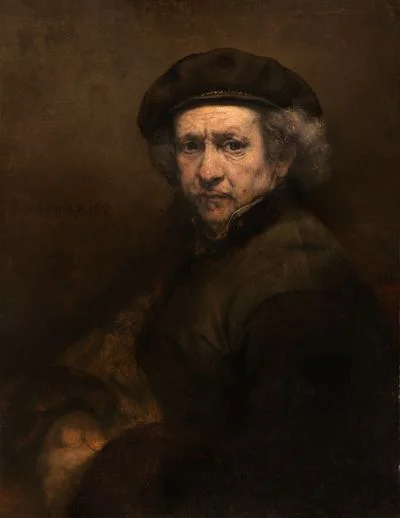
Night Watch. Self-portraits of aging. Master of light who painted the human soul.
Conversation Starters
Life Journey
Rembrandt Harmenszoon van Rijn was born as the ninth child of a prosperous miller in Leiden. Growing up near a windmill on the Rhine River, he would later immortalize Dutch life in his paintings.
Rembrandt enrolled in the Latin school in Leiden, receiving a classical education that would influence his later historical and biblical paintings. He showed early artistic talent alongside his studies.
Rembrandt briefly enrolled at Leiden University, but his passion for art soon led him to abandon academic studies in favor of apprenticeship with a local painter.
Rembrandt began a three-year apprenticeship with Jacob van Swanenburgh, a painter known for scenes of hell and the underworld. Here he learned the fundamentals of painting.
Rembrandt traveled to Amsterdam to study with the renowned history painter Pieter Lastman. This six-month apprenticeship taught him dramatic composition and narrative storytelling in paint.
Returning to Leiden, Rembrandt established his own painting studio alongside fellow artist Jan Lievens. His early works already showed remarkable skill in capturing light and human emotion.
Stadtholder Frederik Hendrik commissioned a series of paintings depicting the Passion of Christ. This prestigious commission established Rembrandt's reputation beyond his hometown.
Rembrandt relocated to Amsterdam, the wealthy commercial capital, and partnered with art dealer Hendrick van Uylenburgh. His portrait business flourished among the prosperous merchant class.
Rembrandt married Saskia van Uylenburgh, his art dealer's cousin. She became his muse and appeared in many paintings. Their marriage brought social status and financial stability.
At the height of his success, Rembrandt bought an expensive house in a fashionable neighborhood. He filled it with art, curiosities, and costumes used as props in his paintings.
After losing three children in infancy, Rembrandt and Saskia welcomed son Titus, who would survive to adulthood. Titus would become a beloved subject of many tender portraits.
Rembrandt finished his most famous work, the militia group portrait known as The Night Watch. Its dramatic lighting and dynamic composition revolutionized the conventional group portrait.
Shortly after The Night Watch was completed, Saskia died of tuberculosis at age 29. Her death devastated Rembrandt and left him to raise their infant son alone.
Hendrickje Stoffels, a young housekeeper, became Rembrandt's loving companion. Though they never married due to Saskia's will conditions, she remained devoted to him through hardship.
Financial troubles forced Rembrandt into insolvency. His house and prized art collection were auctioned off. Despite this humiliation, he continued painting masterpieces in reduced circumstances.
Hendrickje Stoffels died, possibly of plague. She had selflessly helped manage Rembrandt's affairs and bore him a daughter. Her death left the aging painter increasingly isolated.
Titus van Rijn died just seven months after his marriage, leaving a pregnant widow. The loss of his only surviving legitimate child was a crushing blow to the elderly Rembrandt.
Rembrandt died on October 4, 1669, leaving behind over 300 paintings, 300 etchings, and 2000 drawings. Though he died poor and nearly forgotten, he is now considered one of history's greatest painters.