Quick Facts
Norman king of Sicily. Created a multicultural kingdom where Arabs, Greeks, and Latins flourished.
Conversation Starters
Life Journey
Roger II was born to Roger I of Sicily and Adelaide del Vasto in Mileto, Calabria, into the Norman Hauteville family.
Roger II begins his education, learning Latin, Greek, and the art of governance under the tutelage of Norman and Byzantine scholars.
At the age of 10, Roger II is appointed Count of Sicily by his father, Roger I, following the death of his elder brother, Simon.
Roger II participates in his first military campaign, helping to consolidate Norman control over southern Italy and Sicily.
Upon the death of his uncle, Duke William II, Roger II inherits the titles of Duke of Apulia and Calabria, expanding his realm.
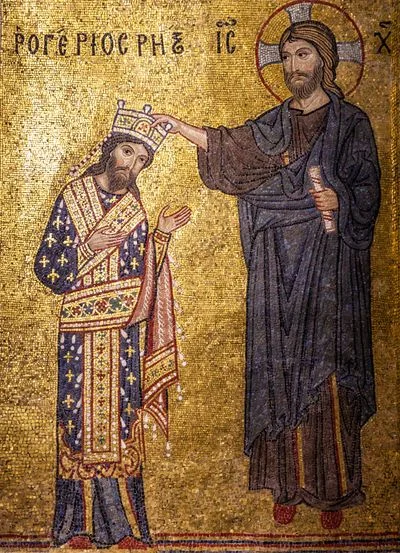
Roger II is crowned the first King of Sicily by Antipope Anacletus II, solidifying his rule over Sicily, southern Italy, and Malta.
Roger II conquers the Principality of Capua, further expanding his territory and consolidating his power in southern Italy.
Roger II defeats Pope Innocent II and his allies at the Battle of Rieti, strengthening his position against the papacy.
Roger II signs the Treaty of Melfi with Pope Innocent II, recognizing his title as King of Sicily and ensuring peace with the papacy.
Roger II marries Elvira of Castile, the daughter of King Alfonso VII of Castile, strengthening diplomatic ties with the Iberian Peninsula.
Roger II captures the island of Corfu, extending his influence into the Adriatic Sea and the eastern Mediterranean.
Roger II faces a rebellion in southern Italy but successfully suppresses it, reaffirming his control over the region.
Roger II begins the construction of the Royal Palace in Palermo, a grand architectural project that reflects his power and wealth.
Roger II leads his last major military campaign, reinforcing his control over the Norman territories in southern Italy.
Roger II dies in Palermo, leaving behind a unified and prosperous kingdom that would influence Mediterranean politics for centuries.