Quick Facts
Patron of France. Carried his head after martyrdom. Still preaching.
Conversation Starters
Life Journey
Denis was born in Italy during the reign of Emperor Decius. Little is known of his early life, but tradition holds he came from a noble family and received an excellent education. The Roman Empire was at this time experiencing a revival of traditional paganism, making Christian faith increasingly dangerous.
The young Denis received his Christian formation in Rome, studying Scripture, theology, and the teachings of the apostolic fathers. He demonstrated remarkable intellect and deep piety, showing early signs of the missionary zeal that would define his life. The persecutions under Emperor Valerian had recently ended, allowing the Church to grow.
Denis studied under the guidance of Pope Dionysius (259-268), whose name he shared. The pope was known for his organizational skills and theological clarity, qualities that would later characterize Denis's own ministry. He learned Greek philosophy alongside Christian doctrine, preparing him for intellectual engagement with pagans.
Denis was ordained a priest, dedicating his life to the service of Christ and His Church. His ordination came during a brief period of relative peace for Christians. He distinguished himself as a preacher capable of explaining the faith to both educated Romans and common people, attracting attention from Church leaders.
Pope Fabian (or according to some accounts, Pope Sixtus II) commissioned Denis to lead a mission to Gaul, the vast Roman province encompassing modern France. Christianity had barely penetrated this region, and the Church sought zealous missionaries to establish the faith among the Gallic and Germanic peoples.
Before departing for Gaul, Denis was consecrated bishop, giving him full authority to ordain priests, confirm converts, and establish churches. He was given two companions, the priest Rusticus and the deacon Eleutherius, who would share his mission and eventually his martyrdom.
Denis and his companions arrived in Lutetia, a small Roman town on an island in the Seine River that would become Paris. The population was largely pagan, worshipping Roman and Celtic gods. Denis established himself on the island, beginning the work that would make him the apostle of France.
Denis constructed a small church on the Ile de la Cite, the island in the Seine that remains the heart of Paris. This modest structure was the first Christian church in the city, the ancestor of Notre-Dame Cathedral. He conducted services, baptized converts, and trained local men for the priesthood.
Denis's preaching brought many Parisians to the faith, including people from all social classes. His ability to refute pagan philosophers and perform works of charity won him respect even among some pagans. The growing Christian community began to alarm the Roman authorities and pagan priests.
The Roman prefect Fescennius Sisinnius summoned Denis to explain his activities. Denis fearlessly proclaimed the Gospel and denounced the pagan gods as demons. The prefect, furious at this defiance, ordered increased surveillance of the Christian community but hesitated to arrest the popular bishop immediately.
Denis and his companions were arrested and imprisoned. According to tradition, they were subjected to various tortures including being stretched on a rack, thrown to wild beasts (who refused to harm them), and burned (but emerged unharmed). These miraculous survivals only increased the faith of their followers.
Released from prison, either through divine intervention or temporary official leniency, Denis continued his mission with even greater urgency. He traveled throughout the region around Paris, establishing Christian communities in surrounding villages. His courage in the face of persecution inspired many conversions.
Denis ordained numerous priests to serve the growing Christian community, ensuring the Church would survive even if he were killed. He established a hierarchy and structure for the Gallic Church, appointing leaders for communities throughout the Paris region. This organization would prove vital after his death.
Under orders from Emperor Maximian, the prefect launched a final crackdown on Christians. Denis, Rusticus, and Eleutherius were arrested and brought before the prefect. Despite promises of rewards and threats of torture, all three refused to sacrifice to the Roman gods or deny Christ.
The three missionaries endured prolonged torture as the authorities attempted to break their faith and force an apostasy that would discourage other Christians. According to legend, Denis celebrated Mass in prison the night before his execution, with Christ himself appearing to give him communion.
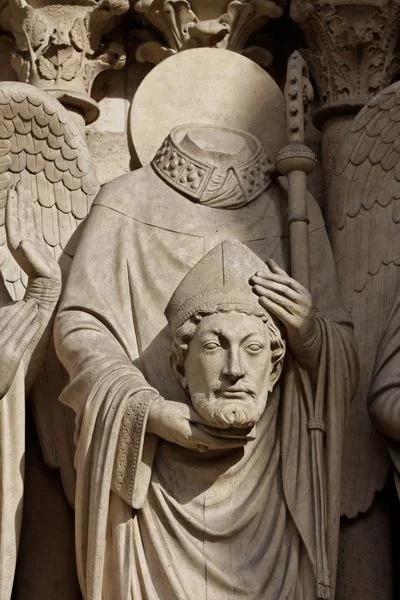
Denis, Rusticus, and Eleutherius were led to the highest hill outside the city, later called Montmartre (Mount of Martyrs), and beheaded. According to the famous legend, Denis picked up his severed head and walked six miles while preaching a sermon, finally falling where the Abbey of Saint-Denis would be built.
A pious Christian woman named Catulla recovered Denis's body and buried it where he fell. This site became a place of pilgrimage, and in the 5th century, Saint Genevieve built a chapel there. The Abbey of Saint-Denis, built over his grave, became the burial place of French kings and a masterpiece of Gothic architecture.
Saint Denis became the patron saint of France and of Paris. His feast day, October 9, was celebrated throughout medieval France. The war cry of French kings, 'Montjoie Saint Denis!', invoked his protection in battle. His cult spread throughout Europe, and he remains one of the most venerated martyrs of the early Church.