Quick Facts
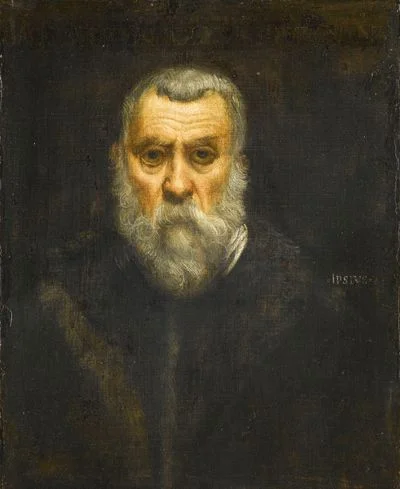
Venetian master: Dramatic light, dynamic movement, Tintoretto redefined Renaissance painting.
Conversation Starters
Life Journey
Tintoretto, born Jacopo Comin, was born to a dyer and his wife in Venice, Republic of Venice.
Tintoretto began his early education in the vibrant artistic environment of Venice, likely receiving basic training in drawing and painting.
Tintoretto briefly apprenticed under the great Venetian artist Titian, but their relationship was short-lived due to artistic differences.
Tintoretto established his own workshop in Venice, where he began to develop his unique and dramatic style, characterized by rapid brushwork and dynamic compositions.
Tintoretto completed 'The Miracle of the Slave,' a groundbreaking work that showcased his innovative approach to perspective and movement, earning him recognition among Venetian artists.
Tintoretto married Faustina de Vescovi, a woman from a noble Venetian family, solidifying his social status and providing him with a supportive partner.
Tintoretto was commissioned to paint a series of large-scale works for the Scuola Grande di San Rocco, a prestigious confraternity in Venice, marking a significant milestone in his career.
Tintoretto completed 'The Last Supper' for the church of San Marcuola, a work that demonstrated his mastery of dramatic lighting and composition.
Tintoretto completed the massive 'Paradise' fresco for the Doge's Palace, one of the largest paintings in the world at the time, solidifying his reputation as a leading Venetian artist.
Tintoretto was admitted to the Venetian Academy of Fine Arts, an honor that recognized his significant contributions to the arts in Venice.
Tintoretto completed 'The Origin of the Milky Way' for the Duke of Bavaria, a mythological painting that showcased his ability to blend classical themes with his dynamic style.
Tintoretto continued his extensive work on the Scuola Grande di San Rocco, adding more paintings to the series, which would become one of his most celebrated achievements.
Tintoretto completed 'The Crucifixion,' a monumental work for the Scuola Grande di San Rocco, which is considered one of his masterpieces for its dramatic and emotional intensity.
Tintoretto began work on another version of 'The Last Supper' for the church of Santa Maria Maggiore, further refining his technique and style.
Tintoretto died in Venice, leaving behind a legacy as one of the most influential and dynamic painters of the Venetian Renaissance.