Quick Facts
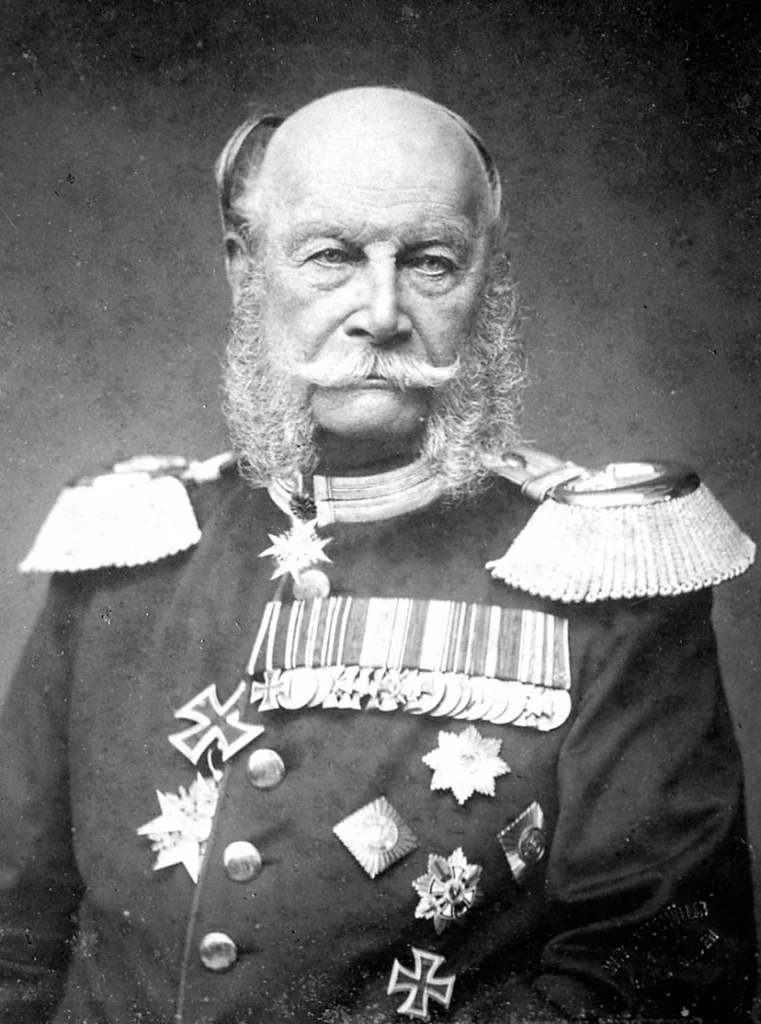
Germany unified! Wilhelm I: First Emperor forged in Prussian steel.
Conversation Starters
Life Journey
Wilhelm I was born to Frederick William III of Prussia and Louise of Mecklenburg-Strelitz in Berlin, Prussia.
At the age of nine, Wilhelm began his military training, reflecting the Prussian emphasis on military discipline and service.
Wilhelm participated in the War of the Sixth Coalition against Napoleon, gaining valuable military experience and earning a reputation for bravery.
Wilhelm was present at the Battle of Paris, one of the final battles of the Napoleonic Wars, where the Allies defeated Napoleon.
Wilhelm fought in the decisive Battle of Waterloo, which marked the end of the Napoleonic Wars and solidified his military credentials.
Upon the death of his father, Frederick William III, Wilhelm became the Prince of Prussia and heir to the throne.
Wilhelm played a crucial role in suppressing the Revolution of 1848, which sought to establish a unified German state and a constitutional monarchy.
Wilhelm became the regent of Prussia after his brother, Frederick William IV, was declared mentally unfit to rule.
Wilhelm ascended to the throne as King of Prussia after the death of his brother, Frederick William IV, beginning his reign with Otto von Bismarck as his chief minister.
Prussia defeated Austria in the Austro-Prussian War, solidifying Prussia's dominance in Germany and advancing the process of unification.
Following the Franco-Prussian War, Wilhelm was proclaimed the first German Emperor in the Hall of Mirrors at the Palace of Versailles.
Wilhelm I founded the German Empire, uniting the various German states under Prussian leadership, marking a significant milestone in German history.
Wilhelm survived two assassination attempts, which increased his popularity and reinforced his image as a symbol of German unity and stability.
Wilhelm celebrated his 20th anniversary as the King of Prussia and the 10th anniversary as the German Emperor, marking a period of significant achievements.
Wilhelm I died in Berlin, having served as the King of Prussia and the first German Emperor, leaving a legacy of German unification and modernization.