Datos rápidos
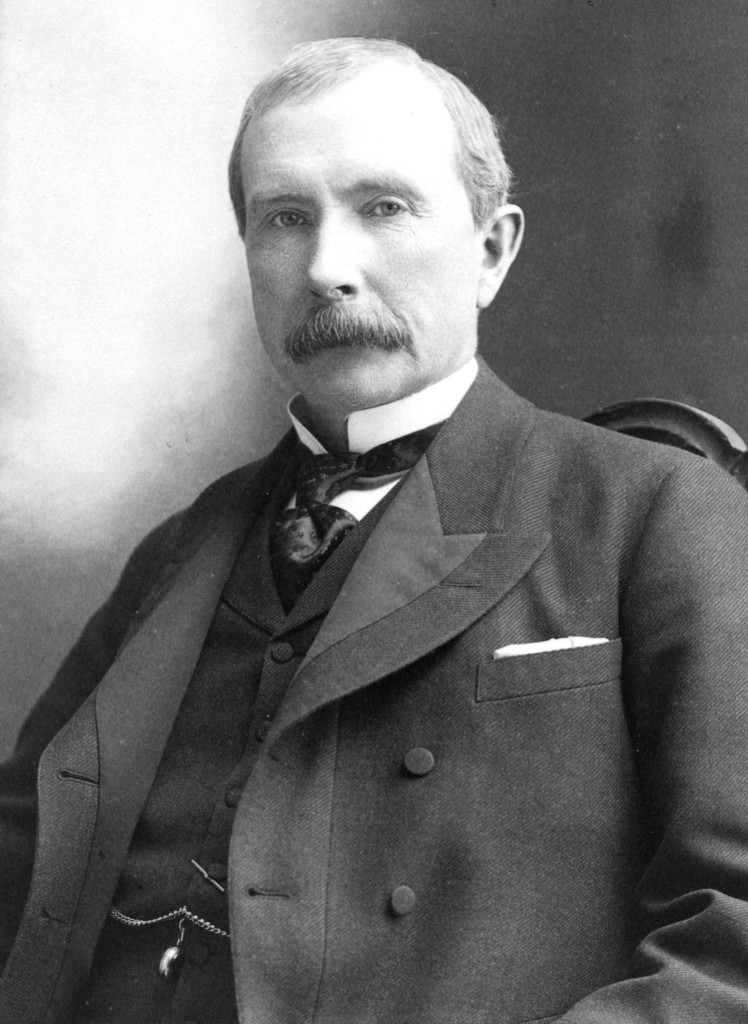
The industrialist who founded Standard Oil and became one of the wealthiest Americans in history.
Inicios de conversación
Trayectoria vital
John Davison Rockefeller was born to William Avery Rockefeller and Eliza Davison in Richford, New York. His father was a traveling salesman, and his mother instilled strong religious and moral values in him.
The Rockefeller family moved to Strongsville, Ohio, where John attended high school and began to develop his business acumen through various odd jobs and entrepreneurial ventures.
Rockefeller enrolled in Folsom's Commercial College in Cleveland to study bookkeeping, penmanship, and business practices. This education laid the foundation for his future business success.
Rockefeller began his first job as an assistant bookkeeper at Hewitt & Tuttle, a merchant firm in Cleveland. He learned the intricacies of business and developed a strong work ethic.
Rockefeller and Maurice B. Clark formed a partnership to engage in the produce commission business. This venture was successful, and it marked the beginning of Rockefeller's business empire.
Rockefeller and his partners invested in an oil refinery in Cleveland, recognizing the potential of the oil industry. This investment would prove to be a pivotal moment in his career.
Rockefeller bought out his partners in the oil refinery business, forming Rockefeller & Andrews. This strategic move allowed him to have greater control over his business operations.
Rockefeller married Laura Celestia Spelman, a woman from a prominent abolitionist and temperance family. Their marriage was a union of mutual respect and shared values, and they had six children together.
Rockefeller, along with his brother William and other partners, formed the Standard Oil Company. This marked the beginning of his efforts to dominate the oil industry through vertical integration and strategic acquisitions.
Rockefeller orchestrated the Cleveland Massacre, a series of acquisitions and mergers that put him in control of nearly all the oil refineries in Cleveland, solidifying his dominance in the oil industry.
Rockefeller continued to acquire competitors and consolidate his control over the oil industry, forming a monopoly that would come to be known as the Standard Oil Trust.
Rockefeller reorganized Standard Oil into a trust, which allowed him to centralize control and further expand his business. The trust became the largest and most powerful corporation in the world at the time.
The Ohio Supreme Court ruled that the Standard Oil Trust was illegal and ordered its dissolution. However, Rockefeller had already reorganized the company into a holding company structure to maintain control.
Rockefeller retired from active management of Standard Oil, transitioning into a role as a board member and focusing more on philanthropic endeavors.
Rockefeller reorganized Standard Oil into a holding company in New Jersey, which allowed him to maintain control over the company and continue its expansion.
Rockefeller established the Rockefeller Institute for Medical Research (now Rockefeller University) to advance medical knowledge and combat disease. This was one of his major philanthropic initiatives.
Rockefeller founded the General Education Board to support education in the United States, particularly in the South. The board provided funding for schools, teacher training, and educational reforms.
Rockefeller established the Rockefeller Foundation, one of the world's largest and most influential philanthropic organizations. The foundation focused on health, education, and scientific research.
The U.S. Supreme Court ruled that Standard Oil was an illegal monopoly and ordered its dissolution into 34 independent companies. Despite this, Rockefeller's wealth and influence remained significant.
John D. Rockefeller died at The Casements, his winter home in Ormond Beach, Florida. He left behind a legacy as one of the wealthiest and most influential Americans in history, known for his business acumen and philanthropy.