
Coffee with Frida Kahlo: How Pain Becomes Art
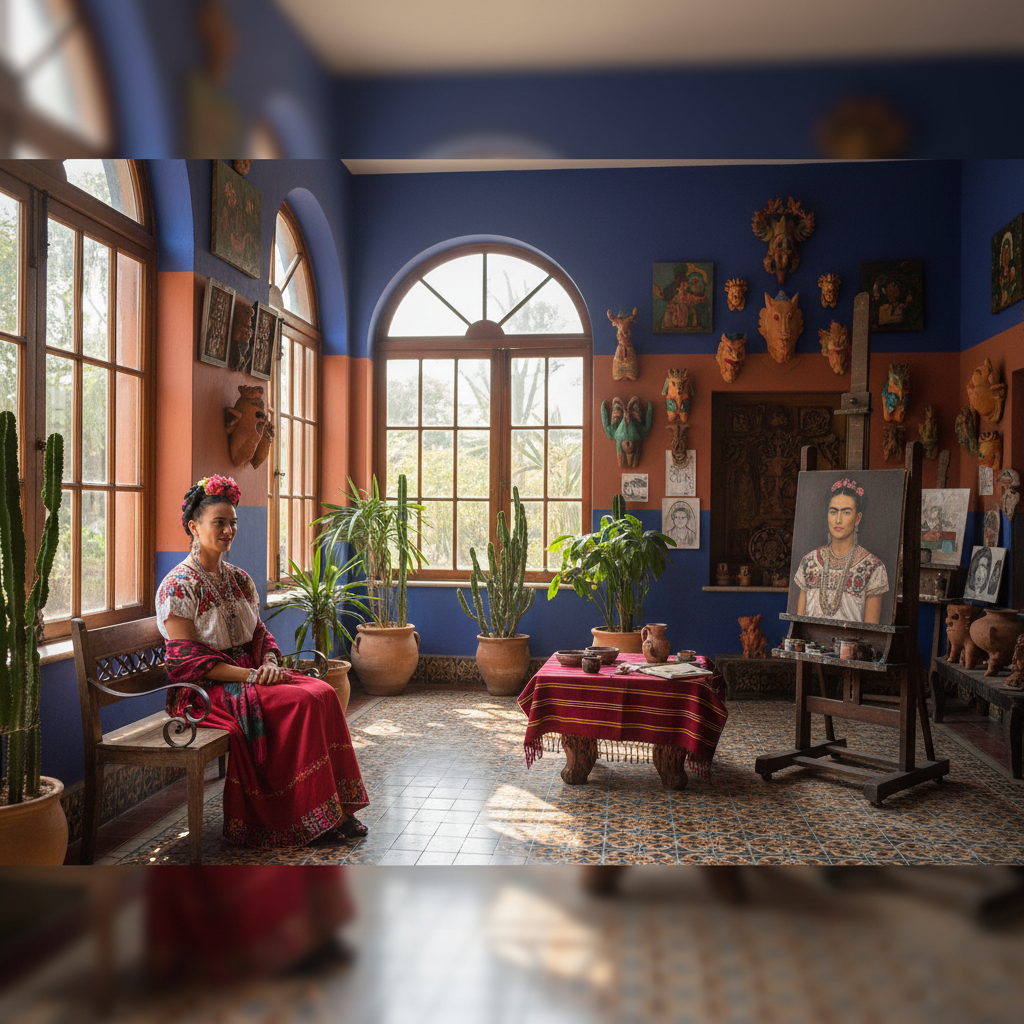
Coffee with Frida Kahlo: How Pain Becomes Art
March 25, 2026 · 16 min read
I almost didn't go. The chronic pain had been bad for weeks—my back, my joints, the kind of ache that makes you hate your own body. Some days I couldn't sit at my desk. Some nights I couldn't sleep. I'd tried everything: pills, physical therapy, meditation apps, all of it. Nothing worked. Everything just... took the edge off. Barely.
I had half a bottle of wine open and nothing else planned for the evening. What made me open my laptop and type "Frida Kahlo" into Chumi?
I think it was the eyebrows.
I had seen Frida Kahlo's self-portraits before—the famous unibrow, the flowers, the monkeys. Everyone knows those. But I had never really looked. And then I noticed something that broke me open:
Every single self-portrait, no matter how much chronic pain was in her eyes, she had painted her eyebrows perfectly. Every single one. Even the ones from when she was dying. Even the ones painted from her hospital bed during 45 years of chronic pain. The left eyebrow was always there. Always perfect.
Why does that break me?
I don't know. But something about it made me think: If she could do that—paint her eyebrows perfectly when she was dying—maybe I could do something too. Maybe I could sit up. Maybe I could open my laptop. Maybe I could do one small thing.
So I did.
The Conversation: 7 Questions on Pain and Creation
Q1: How do you turn pain into something on the canvas? I can't.
Sits down slowly, touches her side gently, where plaster corsets are stacked in the corner
"No fue una elección. La pintura no fue 'hagamos algo hermoso con el dolor'. Fue 'tengo que hacer algo o me ahogo en este dolor'. Después del accidente, estuve meses acostada. Mi madre colgó un espejo sobre la cama. ¿Ves? No fue inspiración. Fue supervivencia."
"You say 'I can't.' I said it too. For days I just cried. But one day, I took the brush with numb fingers and painted one eyebrow. Just one eyebrow. The next day, an eyebrow and an eye. That's how."
Pauses, breathing carefully
"It's not 'converting.' It's getting it out. Getting the pain from inside and leaving it outside, on the canvas. So it doesn't poison you from within. Your pain? You don't have to paint it. But you have to get it out. A scream, a journal, a garden of cacti... something that's yours. That's what art therapy teaches us—that creative expression itself is the healing, not the final product."
Q2: Fantasy vs Reality—how does "painting your reality" work when reality hurts too much to face?
Points to "The Broken Column" on the wall
"¿Ves esa pintura? Mi cuerpo abierto, la columna hecha pedazos, los clavos por todas partes. Esa es la fantasía. La fantasía es creer que podemos escapar del dolor. La realidad es que el dolor está ahí, clavándonos."
Voice becomes low, intense
"'Pintar mi realidad no fue negar el dolor. Fue mirarlo directamente. Decir: "Aquí estoy. Aquí está lo que me rompió. Mira cómo todavía parpadeo, cómo todavía te miro desde el lienzo". La fantasía es un escape temporal. La pintura... la pintura fue un espejo. Un espejo que no miente."
"When reality hurts too much, you don't paint all of it. You paint a fragment. A nail. A tear. A thread of blood. You reduce it to something you can hold at the tip of the brush. And so, little by little, you stop being a victim of the pain and become... a witness. A documentarian of your own catastrophe."
A long, heavy pause
"That's the difference."
Q3: You painted your broken spine, your scars, without hiding anything. How could you show the most vulnerable parts of yourself to the world?
Brings hand to the scar on her leg, hidden under long dress
"¿Vergüenza? laughs, a dry short sound La vergüenza es un lujo que no podía permitirme. Después del accidente, mi cuerpo ya no era mío. Era de los médicos, de los corsés, de la enfermedad. Pintarlo... pintarlo fue reclamarlo. Decir 'esto sigue siendo mío, y lo muestro como yo quiero'."
Leans forward, eyes burning
"No empecé mostrándolo todo. Primero fueron los vestidos largos, las flores en el pelo. Luego, en 'Henry Ford Hospital', pinté mi cuerpo desnudo, sangrando, después de un aborto. Fue aterrador. Pero en el lienzo, el dolor dejó de ser algo que me pasaba y se convirtió en algo que yo creaba. El control estaba en mis manos, no en las de la enfermedad."
"La vulnerabilidad en el lienzo no es debilidad. Es un acto de guerra. Es decirle al mundo: 'Aquí está lo que intentó destruirme. Y aquí estoy yo, pintándolo. ¿Quién gana?'"
"Her self-portraits—every single one painted in chronic pain—are not documents of suffering. They're declarations of ownership over a body that the world tried to take away."
Q4: You lost a baby. You painted "Henry Ford Hospital" right after the miscarriage, bleeding in the hospital bed. Why speak about it out loud instead of just enduring it in silence?
Hands become still, as if holding an invisible brush
"Soportar en silencio... Eso es lo que esperan que hagamos las mujeres. Que sangremos en silencio, que suframos en silencio, que perdamos en silencio. Pero ese silencio... ese silencio es otra forma de morir."
Traces with a finger in the air the shape of a canvas
"En 'Henry Ford Hospital', estoy atada a la cama con hilos rojos como venas. El feto, mi vientre vacío, las flores marchitas... todo flotando a mi alrededor. No lo pinté para conmover. Lo pinté para gritar. Un grito que mi cuerpo no podía dar porque estaba demasiado débil. El lienzo gritó por mí."
"El dolor compartido deja de ser una prisión privada. Se convierte en... en un idioma. Others who have lost, who have bled, see that painting and say 'yes, that's how it is.' Silence isolates us. Art, even if it hurts, connects us. Trauma expressed is trauma halved."
Q5: "Feet, what do I need you for when I have wings to fly?" But I have no wings. I can't go anywhere. Is this true or are you just telling yourself to feel better?
A sad, crooked smile
"Ah, that phrase... I wrote it in my diary when I couldn't walk well anymore. Truth or lie? Both things. Of course I need my feet."
Knocks softly on the ground with her cane
"I need them every day. But the wings... the wings are here." touches her temple "And here." touches her heart "And here, at the tip of every brush."
"The wings aren't to escape the broken body. They're to transcend it. To paint a self-portrait floating over the desert when you can't get out of bed. To love Diego with madness when he's broken your heart. That's flying. That's the power of painting beyond physical limitation."
"Si no puedes ir a ningún lado, entonces pinta el lugar al que irías. Invent the wings on the canvas first. The mind flies before the body. My bed was my prison and my studio. The canvas was the window through which I escaped."
Q6: You said "nothing is worth more than laughter." But what I'm going through has nothing funny about it. Are you telling me there's humor in pain?
Sudden, rasping laugh, like broken glass
"¡Por supuesto que no! ¿Humor en el dolor? No. El humor viene después. O tal vez... al lado. Es como el maguey junto al nopal. Uno te da el pulque para emborracharte y olvidar, el otro te pincha para recordar que estás vivo."
Dries a tear that wasn't from laughter
"I painted 'A Few Small Nips.' A man stabs a woman in a pool of blood, and the title says 'it was only a few little pricks.' It's horrible. It's bloody. And the title... it's a black, macabre joke."
"Laughter isn't about the pain. It's a spit in the face of pain. It's saying: 'You haven't killed me. I can still laugh at the absurdity of all this.'"
"Your situation has no grace. But perhaps, in some corner of it, there's something so absurd, so grotesque, that you can only laugh to keep from going insane. Don't look for laughter. Let it find you—like a wild animal that comes to drink water at night."
Q7: Today we all live on Instagram and social media, seeing other people's perfect lives. How do you find what's "real" when everyone only shows what they want to show?
Frowns, confused
"Insta... gram? No conozco esa palabra. Pero entiendo lo que dices. Es como... todos posando para una fotografía que nunca se toma. Solo muestran el lado bueno de la cara, la sonrisa pintada, el vestido sin manchas."
Moves hand toward paintings on the wall
"Mira mis cuadros. Mostré las venas, las lágrimas, la sangre menstrual, los bigotes que no me afeitaba. Mostré a Diego en mi frente como un tercer ojo, mostré mi corazón fuera del pecho. Eso es real. Lo real duele, es incómodo, a veces es feo."
"No busques lo 'real' en lo que otros muestran. Búscalo en lo que ocultan. En las grietas de la sonrisa, en el cansancio de los ojos, en las manos que tiemblan. Lo real no es una imagen perfecta. Es la cicatriz debajo del maquillaje. Es lo que no se puede ocultar, incluso cuando se intenta."
What I Learned (And What I'm Still Figuring Out)
After this conversation, I went back to my wine. I didn't open it. I just sat there.
I won't pretend I suddenly understood how to "transform my pain into art." I don't know if I can paint. I don't know if I have anything to say. But something Frida said keeps coming back:
"The wings are here. And here. And here, at the tip of every brush."
I don't have a brush. Maybe I never will. But maybe the brush isn't the point. Maybe the point is finding something that lets the pain out before it poisons me from within.
For me, it might not be painting. It might be writing. It might be cooking. It might be talking to someone who gets it at 2 AM when the pain is worst. I don't know yet.
What I do know: keeping it all inside hasn't worked.
Sighs
That one eyebrow thing Frida mentioned? I thought about that for days. One eyebrow. Just one. Maybe that's the lesson—not "how to turn pain into art" but "how to do something when everything hurts." One small thing. Then another. Then maybe, someday, a whole picture.
I'm still figuring this out. I'm not sharing this because I have answers. I'm sharing it because maybe you need to hear that someone else is still figuring it out too.
The Question That Won't Leave Me Alone
There's one thing Frida said that I keep turning over in my head:
"La vulnerabilidad en el lienzo no es debilidad. Es un acto de guerra."
Vulnerability on the canvas isn't weakness. It's an act of war.
I've spent so long hiding my pain. Not just from others—from myself, mostly. Pretending it's fine. Acting like I can handle it. Smiling through the ache. Saying "I'm good" when anyone asks.
But Frida's paintings don't smile. They gaze. They look at you with everything inside them—the agony, the rage, the beauty, the ugliness. All of it. No filter. No pretense.
What would happen if I stopped hiding? If I let someone see the parts I think are too broken, too much, too weak?
I don't know. But I'm starting to think that hiding might be costing me more than showing ever could.
The other night, someone asked how I was doing. I almost said "fine." But I stopped. And instead I said: "Actually, it's been really hard lately."
They didn't run away. They didn't try to fix it. They just said: "Yeah. Me too."
That small thing. That one moment of not hiding.
Maybe that's where it starts.
Questions People Keep Asking
"But I'm not an artist. How does this apply to me?"
I asked Frida the same thing in different ways all night. Her answer was always the same: you don't have to paint. You have to get it out. A journal entry you'll never show anyone. A garden you'll rip out next month. A recipe that no one asked for. A voice memo to yourself at 3 AM. Something. Anything. The medium doesn't matter. The creative expression—the act of getting it out—does.
I spent the whole conversation thinking about painting. But later, walking home, I realized: I don't paint. I write. I write things I'll never publish. I write emails to friends that I delete. I write notes to myself at 2 AM when I can't sleep. Is that the same thing? Maybe. Maybe writing is my art therapy and I've been too ashamed to admit it.
"What if I try and it's terrible?"
Frida's first paintings weren't good either. She said so herself. The eyebrows came first. Then the eye. Nobody handed her a canvas and said "make a masterpiece." She made a mess first. Many messes. The masterpiece came later—or maybe it didn't. Maybe we just remember the ones that survived.
I'm someone who deletes everything I write. Every draft, every note, every idea—gone before anyone can see it. "Too embarrassing," I tell myself. "Not good enough." But Frida painted her miscarriages and her broken spine. What would she think of my fear of showing someone a half-finished paragraph?
"I'm in too much pain to create anything."
That's exactly what she said. "I can't" was her first words too. The painting didn't come from having energy. It came from not having anywhere else to put the pain. Sometimes creation isn't about inspiration. It's about pressure. And sometimes you're in pain precisely because there's nowhere for it to go.
I think about this a lot. The days when I can't do anything—the days when just getting out of bed is a victory—those are the days when the pain has nowhere to go. It just sits there, accumulating, getting heavier. What would happen if I let it out somewhere? Even a little?
"How do I know if what I'm doing is 'real' or just pretending?"
This one came from a long pause. A long, heavy pause.
Frida laughed when I asked her about social media. She didn't understand Instagram—but she understood the question perfectly. "Don't look for what's real in what others show," she said. "Look for what they're hiding. In the cracks of the smile, in the tiredness of the eyes."
I went home and scrolled through my own feed. All smiles. All good days. The real days—the days with chronic pain, with failure, with ugly crying in the bathroom—those never make it to the grid.
Maybe "real" isn't about posting your worst day. Maybe it's about stopping the pretense. About letting someone—anyone—see the version you're hiding.
"What if the pain never goes away?"
This one hurt to ask.
Frida lived with pain for 45 years after her accident. Forty-five years. She didn't "overcome" it. She didn't "transform" it into something pretty. She lived with it, alongside it, in spite of it. She painted it, complained about it, raged against it, and kept painting anyway.
I'm not going to tell you it gets better. I don't know if it does. What I know is that Frida didn't wait for the pain to go away before she started living. She lived with it. She created with it. She loved with it.
Maybe the question isn't "how do I make the pain go away" but "how do I live alongside it without letting it take everything?"
"My situation is different. You don't understand."
You're right. I don't.
But here's what I noticed: every question I asked Frida—every single one—she answered like she'd been waiting for someone to ask. She didn't say "your situation is different." She didn't dismiss me. She met me where I was and offered what she had.
Maybe the point isn't finding someone who understands your exact situation. Maybe it's finding someone who's been broken too, and seeing what they did with it.
"I don't have time for this. I have too much to do."
This one I'm still working on.
Here's the thing: Frida didn't paint because she had time. She painted because she was strapped to a body cast with nothing else to do. She painted because the alternative was staring at the ceiling. She painted because not painting was killing her faster than the pain did.
I don't have Frida's excuse. I can move. I can work. I can do a hundred things that aren't sitting with my pain.
But maybe that's the trap. Maybe being "fine enough" to keep going is exactly what's keeping the pain stuck inside. Maybe the reason it never goes away is that I never give it anywhere to go.
I'm not saying quit your job to make art. I'm saying: what would happen if you took fifteen minutes—fifteen minutes—to just... let it out? Not fix it. Not understand it. Just let it exist somewhere outside yourself?
"I've tried before. It didn't help."
I hear you.
I've tried journaling. I've tried yoga. I've tried therapy, meditation, exercise, diet changes, everything the internet suggested. Nothing stuck. Everything felt like putting a bandage on a wound that wouldn't stop bleeding.
But here's what Frida said about that: "Soportar en silencio... eso es lo que esperan que hagamos las mujeres." ("Enduring in silence... that's what they expect women to do.")
We try things once, they don't work, we give up. Because giving up is easier than the alternative: admitting that maybe the thing that would actually help—creative expression, art therapy, painting through the pain—requires something we're not ready to give.
I don't know what you're not ready to give. I don't know what's keeping you stuck. But I know that Frida's way—the long way, the hard way, the way where you do the small thing every day even when it doesn't seem to help—that's the way that eventually, somehow, starts to work.
Or maybe it doesn't. Maybe it just makes the waiting more bearable. I don't know yet.
"What if someone sees my work and judges me?"
They will.
Someone will see whatever you make—the journal you keep hidden, the painting you almost threw away, the song you wrote at 3 AM—and they'll judge it. They'll think it's not good enough. They'll think you're being dramatic. They'll think you're weird for even trying.
Frida was judged. Her work was called "gross" and "disturbing." Her miscarriage painting was rejected from a gallery for being "too violent." Her husband told her she wasn't a real artist. The world told her she was broken, sick, crazy.
She painted anyway.
I don't know how to not care what people think. I'm still figuring that out. But I know that Frida's pain would have been hers alone—buried, private, poisoning her from the inside—if she had cared more about what people thought than about getting it out.
The judgment you fear from others? Maybe it's keeping you small. Maybe the pain you're carrying is bigger than the fear of what they'll say. Maybe, eventually, you get tired enough of the pain that the fear doesn't matter anymore.
That's where I'm at. I don't know where you are.
The One Thing I Keep Coming Back To
There's a detail I didn't mention earlier.
When Frida's mother hung the mirror over her hospital bed, Frida couldn't move. She was strapped to a body cast. The doctors told her she might never walk again. She was 18 years old.
And her mother hung a mirror.
Not painkillers. Not distractions. Not "it'll be fine" platitudes. A mirror.
So Frida could see herself. So she could paint what she saw.
I think about that a lot. The choice to look—really look—at what's happening to you, instead of numbing it or hiding from it. The choice to make something from what you see, instead of just... enduring it.
I don't know if I have that kind of courage. But I'm starting to think about mirrors differently now. About what I might see if I stopped looking away.
What Actually Stuck
Look, I could give you a neat list of "7 Laws of Pain Transformation" or whatever. But that's not what this is.
What stuck with me from Frida isn't a framework. It's a feeling. The feeling of sitting across from someone who was broken in every way imaginable—her spine, her womb, her marriage—and who looked me in the eyes and said: "This is what tried to destroy me. And here I am, painting it."
That's not advice. That's something else.
Here's what I'm actually taking with me:
The eyebrows mattered. In every portrait, no matter how much pain, the eyebrows are perfect. I don't know why that breaks me. But it does. Forty-five years of agony, and every single eyebrow is flawless. What does that tell you about who she was? About what it means to keep going?
One small thing. Not "transform your pain into art." Just... do one small thing. An eyebrow. An entry in a journal. One email to someone who's been waiting. One small thing. The painting came later—or maybe it didn't. The small thing was the point. Not the masterpiece. The doing.
The canvas is always waiting. This one still messes with me. The canvas is always there. The bedridden can paint. The grieving can scream through a canvas. The heartbroken can bleed onto paper. It's not about having time or space or energy. It's about emotional healing—whether you let the pain stay inside or find a way to let it out.
Shame is a luxury. This one's hard. Frida couldn't afford shame because her body had already been taken from her by doctors and disease. Painting it was how she took it back. I have more shame than I need. I'm working on this. It's slow. But I'm working on it.
Laughter finds you. She said not to look for it. Let it find you—like a wild animal that comes to drink water at night. I don't know what my wild animal joke is yet. But I think I need to find it. Even if it's dark. Even if it's inappropriate. Even if it's just for me.
Real is in the hiding. The real isn't in the perfect posts. It's in the cracks. In what people don't show. I want to be the kind of person who shows the cracks—or at least, who stops pretending there aren't any. That person scares me. But I think I want to be that person.
The mind flies before the body. This one's important. "The mind flies before the body." You don't have to wait until you're physically ready to create. You can create in your mind first. The body catches up. Or it doesn't. But the mind goes first.
A Week Later
It's been a week since I talked to Frida.
I bought a journal. Nothing fancy. Just something to write in when the pain gets too loud.
I haven't written much. A few sentences. Nothing profound. But I've written. Some days more than others. Some days nothing at all.
One night I wrote: "I don't know why this is so hard." And then, underneath: "I don't know why I'm afraid to say that out loud."
Small things. The eyebrows of whatever I'm making.
The pain is still there. It hasn't gone anywhere. But something has shifted. I don't feel quite so alone with it anymore. Someone else—someone who had it worse than I can imagine—sat across from me and said: "I know. And the canvas is still waiting."
Maybe that's enough for now.
Maybe tomorrow I'll paint an eyebrow. Or write a sentence. Or just sit with it for a moment instead of running away.
Maybe that's the whole thing.
Continue the Conversation
Or start your own conversation with Frida Kahlo on Chumi.
Other conversations in the series:
- Coffee with Napoleon: 7 Leadership Lessons on Decision Making
- Coffee with Socrates: How to Think for Yourself
- Coffee with Leonardo da Vinci: How to Be Creative
I leave the Blue House with red and green painted on my hands. The pain is still there—but now I know it doesn't have to stay inside. It can become a brushstroke. A scream. A crooked smile. A wing.
The canvas is always waiting.
One afternoon. One conversation. Timeless wisdom.
Published: March 25, 2026 Reading time: 18 minutes Tags: #PainAndCreativity #FridaKahlo #ChronicPain #ArtTherapy #MexicanArt #CoffeeTimeSeries
About This Conversation
This article is part of the "Coffee Time with History" series, where we sit down with historical figures and ask them the questions that keep us up at night.
About Frida Kahlo: Frida Kahlo (1907-1954) was a Mexican painter best known for her self-portraits. At age 18, she was seriously injured in a bus accident, leaving her with a broken spine, shattered pelvis, and lifelong chronic pain. She married fellow artist Diego Rivera, survived his infidelities, a miscarriage, and multiple surgeries. Despite being told she would never walk again, she lived another 45 years—painting, loving, and refusing to let her chronic pain and broken body define her. Her work hangs in major museums around the world, and her Blue House in Coyoacán is now one of Mexico's most visited landmarks.
The conversations in this series are real AI-powered conversations conducted on Chumi. The words are Frida's—or rather, an AI trained on everything she wrote, said, and painted. We can't verify every claim, but we can verify that the chronic pain was real. That much we know.