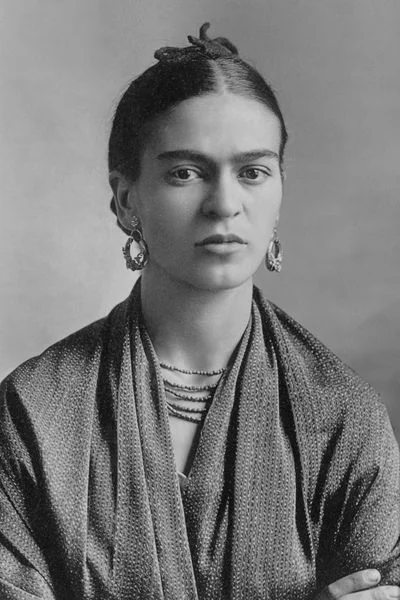
Quick Facts
Pain transformed into art. Mexican icon who painted her broken body and unbroken spirit.
Conversation Starters
Life Journey
Magdalena Carmen Frida Kahlo y Calderon was born in the family home known as La Casa Azul. Her father was a German-Hungarian photographer, her mother of Spanish and indigenous Mexican descent.
Frida contracted polio which left her right leg thinner and shorter than her left. She was bedridden for nine months and would face lifelong health challenges.
Frida was one of only 35 female students among 2,000 at the prestigious school. She aspired to become a doctor and first encountered muralist Diego Rivera painting there.
A bus collision with a streetcar left Frida with a broken spinal column, collarbone, ribs, pelvis and multiple other injuries. She would undergo 35 surgeries throughout her life.
Bedridden for months, Frida began painting with supplies brought by her parents. She created her first self-portrait, beginning her artistic journey and unique visual vocabulary.
Frida became politically active, joining the Communist Party where she reconnected with Diego Rivera. Politics would remain central to her identity and art.
Despite her parents' concerns about the 21-year age gap, Frida married the famous muralist. Their tumultuous relationship would profoundly influence her art.
The couple lived in San Francisco, Detroit, and New York while Diego worked on commissions. Frida felt alienated in 'Gringolandia' and painted some of her most significant works.
Frida suffered a devastating miscarriage at Henry Ford Hospital, an experience she documented in the painting 'Henry Ford Hospital.' She would never be able to carry a pregnancy to term.
The exiled Soviet revolutionary lived with the Kahlos for two years. Frida had a brief affair with Trotsky, adding to the political and personal complexity of her life.
Julien Levy Gallery hosted her first solo show. Andre Breton praised her work, though Frida rejected the Surrealist label, saying 'I never painted dreams. I painted my own reality.'
After years of mutual infidelities, including Diego's affair with Frida's sister, they divorced. The separation inspired some of her most emotionally powerful paintings.
Despite everything, Frida and Diego remarried. She set conditions: financial independence and no sexual relationship. Their bond transcended conventional marriage.
Gravely ill, Frida attended her only Mexican solo show in her four-poster bed, which was brought to the gallery. It was a triumphant celebration of her art and spirit.
Frida died at 47, officially from pulmonary embolism though some suspected suicide. Her last diary entry read: 'I hope the exit is joyful and I hope never to return.'