Quick Facts
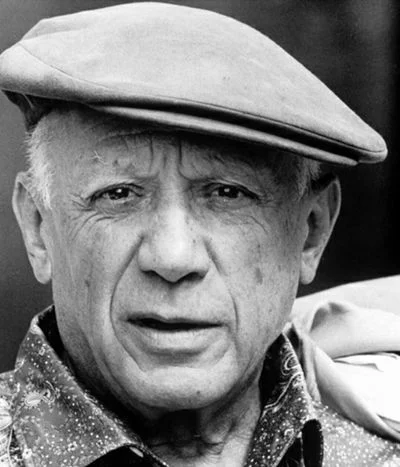
Guernica. Les Demoiselles. Cubism. Reinvented art more times than anyone.
Conversation Starters
Life Journey
Pablo Ruiz Picasso was born to José Ruiz Blasco, an art teacher, and María Picasso López. His father recognized his exceptional talent early and began training him in drawing and painting from childhood.
Picasso began formal art training under his father's guidance. By age seven, he was already producing accomplished drawings, and his father reportedly gave up painting after seeing his son's superior talent.
Picasso enrolled at the prestigious La Llotja art school in Barcelona, where his father taught. He completed the entrance examination in a single day, a process that normally took a month, astonishing the faculty.
Picasso's painting 'Science and Charity' won an honorable mention at the Fine Arts Exhibition in Madrid. He briefly attended the Royal Academy of San Fernando but found academic instruction stifling.
Picasso made his first trip to Paris, the center of the European art world. He visited the Universal Exhibition and was exposed to the works of Impressionists and Post-Impressionists that would influence his development.
Following the suicide of his close friend Carlos Casagemas, Picasso entered his Blue Period, characterized by somber paintings in shades of blue depicting poverty, isolation, and human suffering.
Picasso settled permanently in Paris at the Bateau-Lavoir studio in Montmartre. His work transitioned to the Rose Period, featuring warmer colors and circus performers, reflecting his happier circumstances.
Picasso completed 'Les Demoiselles d'Avignon,' a revolutionary painting that broke with traditional perspective and depicted figures with African mask-like faces. This work laid the foundation for Cubism.
Working closely with Georges Braque, Picasso developed Analytic Cubism, fragmenting objects into geometric forms viewed from multiple angles simultaneously. This revolutionary style transformed modern art.
Picasso married Russian ballerina Olga Khokhlova after designing sets for Diaghilev's Ballets Russes. The marriage brought him into high society but eventually became unhappy, ending in separation.
Picasso's work took on Surrealist influences, featuring distorted figures and dreamlike imagery. Though never officially joining the movement, he exhibited with the Surrealists and influenced their development.
Picasso created 'Guernica' in response to the Nazi bombing of the Basque town during the Spanish Civil War. The monumental anti-war painting became one of the most powerful political artworks of the 20th century.
After the liberation of Paris, Picasso joined the French Communist Party, declaring 'I have become a Communist because our party strives most to know and build the world.' He remained a member until his death.
Picasso married Jacqueline Roque, who became his final muse and devoted companion. She would appear in more of his works than any other woman and remained with him until his death.
Pablo Picasso died of heart failure at his villa in Mougins. He left behind an estimated 50,000 artworks and is regarded as one of the most influential artists of the 20th century, having co-founded Cubism and shaped modern art.