Quick Facts
Id, ego, superego. Father of psychoanalysis who put humanity on the couch.
Conversation Starters
Life Journey
Sigmund Freud was born to Jacob and Amalia Freud, Jewish wool merchants, in Freiberg, Moravia. He was the first of eight children and his mother's favorite, a status he believed shaped his confident personality. Early experiences with anti-Semitism would influence his outsider perspective on society.
The Freud family relocated to Vienna due to economic difficulties. Vienna would remain Freud's home for nearly eighty years, becoming the birthplace of psychoanalysis. The city's intellectual ferment and Jewish community shaped his development as a thinker.
Freud enrolled at the University of Vienna to study medicine, though he initially pursued scientific research rather than clinical practice. He studied under Ernst Brücke, learning the mechanistic approach to biology that would influence his attempt to create a scientific psychology.
Freud completed his medical degree after eight years of study, delayed by his extensive research in neurophysiology. His early work on the nervous systems of fish and cocaine's properties showed his scientific rigor, though financial pressures pushed him toward clinical practice.
Freud met Martha Bernays, daughter of a prominent Jewish family, and began an intense four-year engagement. Their correspondence of over 900 letters reveals Freud's passionate nature and Victorian attitudes toward women. Martha would bear six children and manage his household for fifty-three years.
Freud received a fellowship to study under Jean-Martin Charcot at the Salpêtrière Hospital. Charcot's dramatic demonstrations of hysteria and hypnosis opened Freud's mind to psychological causes of physical symptoms. This experience proved transformative for his future work.
Freud opened his private neurology practice in Vienna and married Martha Bernays. He began treating patients with nervous disorders, experimenting with hypnosis and other techniques. His practice at Berggasse 19 would become the legendary birthplace of psychoanalysis.
Freud published 'Studies on Hysteria' with Josef Breuer, describing the case of 'Anna O.' and the 'talking cure.' This work introduced key psychoanalytic concepts including repression and the unconscious. It marked the transition from neurology to the new science of the mind.
Freud first used the term 'psychoanalysis' to describe his new method of investigating and treating mental disorders. He also developed the seduction theory of neurosis, which he would later abandon in favor of fantasy and the Oedipus complex. His father's death this year prompted intense self-analysis.
Freud published 'The Interpretation of Dreams,' which he considered his greatest work. The book argued that dreams reveal unconscious wishes and introduced the concepts of the id and the Oedipus complex. Though initially selling poorly, it became a foundational text of the twentieth century.
Freud formed the Wednesday Psychological Society, meeting weekly with colleagues to discuss psychoanalytic theory. This group, including Alfred Adler and later Carl Jung, became the nucleus of the psychoanalytic movement. It evolved into the Vienna Psychoanalytic Society.
Freud published 'Three Essays on the Theory of Sexuality,' his most controversial work. It scandalized Victorian society by describing infantile sexuality and the development of sexual drives. The book fundamentally challenged Western attitudes toward childhood and human nature.
Freud delivered lectures at Clark University in America, accompanied by Carl Jung. The enthusiastic reception marked psychoanalysis's international breakthrough. Freud famously remarked that Americans did not realize he was bringing them 'the plague'—a disruptive new understanding of the human mind.
Freud established the International Psychoanalytic Association to organize and standardize the growing movement. Carl Jung was appointed first president. The organization would weather defections, controversies, and world wars to become a major force in twentieth-century thought.
Freud's relationship with Carl Jung, once his chosen heir, ended in acrimonious rupture. Jung rejected Freud's emphasis on sexuality and developed his own analytic psychology. This painful break, following similar splits with Adler and others, reinforced Freud's sense of embattlement.
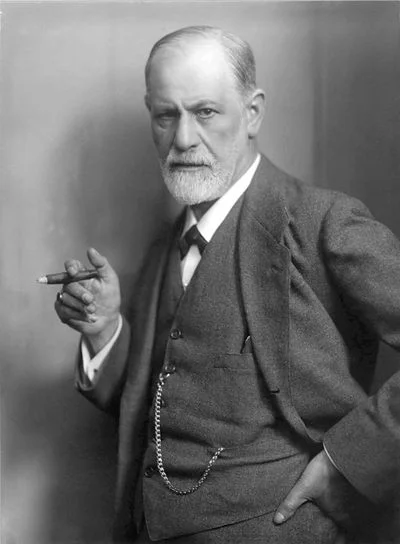
Freud published 'The Ego and the Id,' introducing his structural model of the psyche: id, ego, and superego. That same year, he was diagnosed with jaw cancer from cigar smoking. He would undergo over thirty operations while continuing to write and see patients.
Following the Nazi annexation of Austria, Freud fled to London with his family. Despite his fame, his books were burned and four sisters would die in concentration camps. In London, he was celebrated as a refugee from fascism and continued working despite advanced cancer.
Freud died in London, having asked his physician to administer a lethal dose of morphine to end his suffering from cancer. His revolutionary ideas about the unconscious, sexuality, and the talking cure transformed Western understanding of the mind and remain influential, if controversial, today.