Quick Facts
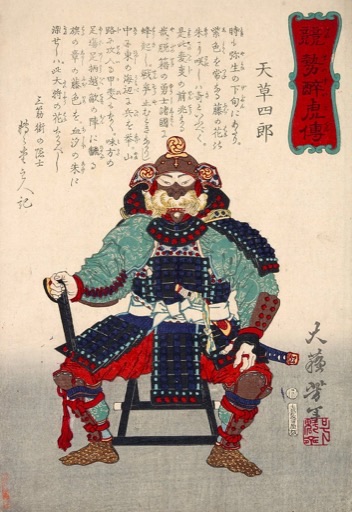
The teenage leader of the Shimabara Rebellion, Japan's largest Christian uprising. Revered as a divine prophet by his followers, he led 37,000 peasants against the Tokugawa shogunate before his tragic death at age sixteen.
Conversation Starters
Life Journey
Born as Masuda Shiro Tokisada to a family of devout hidden Christians. His father, Masuda Yoshitsugu, was a former samurai who served under the Christian daimyo Konishi Yukinaga. Despite the Tokugawa ban on Christianity, his family secretly maintained their Catholic faith, raising young Shiro in the hidden traditions of the Kakure Kirishitan.
Even as a young child, Shiro displayed remarkable intelligence and an unusual charisma that drew adults to him. Local Christians began to notice what they believed were miraculous qualities - his eloquent speech about faith, his ability to recite scriptures, and a spiritual presence that seemed beyond his years. Whispers began spreading among the hidden Christian communities about the prophecy of a divine child.
Received clandestine religious instruction from hidden Christian teachers and possibly surviving missionaries who had gone underground after the persecution began. He learned Latin prayers, Catholic doctrine, and the stories of Christian martyrs who had died for their faith in Japan. This education would later prove crucial in his role as a spiritual leader.
A prophecy attributed to the executed Christian missionary Francisco had foretold that a divine youth would appear to lead the Christians. As Shiro's reputation for wisdom and piety grew, believers began identifying him as this prophesied figure. His name 'Shiro' (四郎, meaning 'fourth son') seemed to confirm this divine destiny, and he became known as 'Heaven's Child' (天童).
The shogunate intensified its persecution of Christians, implementing torture methods including the infamous 'tsurushi' (hanging upside down over pits). Shiro witnessed the suffering of his community as friends and relatives were executed or forced to apostatize. These experiences deepened his resolve and strengthened his bond with the oppressed Christian peasantry.
While continuing his religious studies, Shiro also received training in martial arts and military strategy from ronin (masterless samurai) who had served Christian daimyo before the faith was banned. These former warriors saw in him a potential leader who could unite the persecuted faithful. He learned sword fighting, tactics, and the art of inspiring men to fight.
As persecution and heavy taxation devastated the Christian peasant communities, Shiro emerged as their primary spiritual leader. His sermons brought hope to the desperate, and his presence at secret gatherings inspired the faithful to maintain their beliefs. Former samurai and community elders began looking to this teenage prophet for guidance in increasingly desperate times.
When the peasants of Shimabara rose in revolt against crushing taxation and religious persecution in October 1637, the rebel leaders unanimously chose sixteen-year-old Shiro as their supreme commander. Despite his youth, his reputation as a divinely chosen prophet made him the perfect figurehead to unite the Christian insurgents. He was given the title 'Generalissimo' (総大将).
Within weeks, Shiro had united approximately 37,000 rebels - men, women, and children - under his command. This force included not only peasants but also ronin, former ashigaru (foot soldiers), and craftsmen. They flew Christian banners emblazoned with crosses, the image of the Virgin Mary, and Portuguese inscriptions. It was the largest uprising the Tokugawa shogunate had ever faced.
The rebels seized and fortified the abandoned Hara Castle, transforming it into their stronghold. Under Shiro's leadership, they converted the ruined fortress into an impregnable defensive position overlooking the sea. The castle became a symbol of Christian resistance, with crosses displayed on its walls and daily masses held within. Shiro organized the defense with remarkable military acumen for his age.
When the first shogunate army of 30,000 troops attacked Hara Castle, the rebels under Shiro's command successfully repelled them. The government forces suffered over 4,000 casualties, including several high-ranking commanders. This stunning victory against professional samurai forces seemed to confirm Shiro's divine protection and inspired his followers to believe that God was truly on their side.
The shogunate reinforced their army to over 125,000 troops and began a brutal siege. Cut off from supplies, the rebels faced starvation. Yet under Shiro's spiritual leadership, they maintained their faith and resistance. He led prayers, delivered sermons, and encouraged his people to endure, promising them eternal salvation. Even shogunate commanders reportedly admired the courage of the young prophet.
In a controversial decision, the shogunate requested Dutch naval support. The Protestant Dutch, seeking to eliminate Catholic competition, bombarded Hara Castle from the sea. This betrayal by fellow Christians devastated the morale of the defenders. Shiro reportedly prayed for his enemies' souls while enduring the bombardment, maintaining his faith despite this ultimate betrayal by those who shared his religion's roots.
After three months of siege, with food exhausted and ammunition depleted, the starving defenders prepared for their final battle. Shiro led his remaining followers in one last prayer, then prepared for the end. The shogunate launched their final assault with overwhelming force. The rebels fought to the last, with nearly all 37,000 men, women, and children perishing in the massacre.
Amakusa Shiro was captured and beheaded by the shogunate forces. His severed head was displayed in Nagasaki as a warning to other Christians. According to legend, he remained calm and prayerful until the end, forgiving his executioners and praying for Japan. His death at age sixteen ended the Shimabara Rebellion and marked the final suppression of open Christianity in Japan for over two centuries.