Chumi
Boudica

Boudica

Queen

Start Chat

AI Personality

Quick Facts

Rebellion Against Rome
Iceni Queen
British Warrior

Life Journey

30Birth among the Iceni

Boudicca was born into the Celtic aristocracy of the Iceni tribe in what is now Norfolk, England. Her people were fierce warriors who valued honor, cattle, and the favor of their gods. Roman legions had recently arrived on British shores, changing everything.

43Roman invasion under Claudius

Emperor Claudius launched the Roman conquest of Britain. The Iceni initially became Roman allies rather than subjects, a client kingdom allowed to keep its king in exchange for loyalty. This arrangement would prove fragile and ultimately fatal.

48Marriage to Prasutagus

Boudicca married Prasutagus, king of the Iceni. Their union strengthened tribal bonds and produced two daughters. As queen, Boudicca commanded respect and wielded significant influence, unusual even among the relatively gender-equal Celts.

58Rising Roman demands

Roman administrators increasingly exploited client kingdoms. Tax collectors grew aggressive, Roman merchants called in loans, and soldiers treated Britons with contempt. The Iceni watched their autonomy erode while maintaining an uneasy peace.

60Death of King Prasutagus

Prasutagus died, leaving a will naming Emperor Nero co-heir alongside his daughters, hoping to protect his family and kingdom. Roman law did not recognize female inheritance, and provincial officials saw opportunity in the dead king's estate.

60Roman atrocities

Roman procurator Catus Decianus seized the Iceni kingdom entirely. When Boudicca protested, soldiers stripped and flogged her publicly. Her daughters were raped. Iceni nobles lost their ancestral lands. The Romans had created an implacable enemy.

60Calling the tribes

Boudicca transformed personal outrage into political revolution. She rallied not just the Iceni but neighboring tribes who shared grievances against Rome. The Trinovantes remembered their own stolen lands. A coalition formed around the wronged queen.

60Destruction of Camulodunum

The rebellion struck first at Camulodunum, Rome's colonial capital in Britain. The temple of Claudius, symbol of Roman domination, was besieged. The entire Roman population was massacred. The Ninth Legion, marching to relieve the city, was ambushed and nearly destroyed.

60Burning of Londinium

Boudicca's army marched on Londinium, the commercial heart of Roman Britain. Governor Suetonius Paulinus evacuated those who could flee. The rest were slaughtered without mercy. The city burned so completely that archaeologists still find its destruction layer.

60Destruction of Verulamium

The rebellion consumed Verulamium next, a Romanized British town whose inhabitants had collaborated with the conquerors. Boudicca's forces showed no distinction between Roman and Briton who served Rome. Ancient sources claim seventy thousand died in the three cities.

60Speech before battle

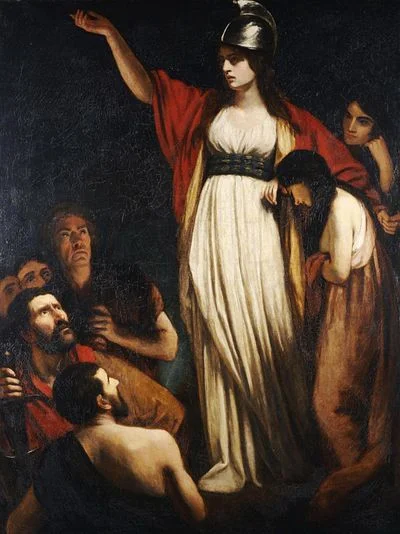
Before the final confrontation, Boudicca reportedly addressed her vast army from her chariot, daughters beside her. She declared she fought not as a queen avenging her kingdom but as an ordinary woman avenging her lost freedom, her scourged body, her daughters' violated innocence.

60Battle of Watling Street

Suetonius chose his ground carefully, a narrow defile where Boudicca's numerical advantage meant nothing. Roman discipline and superior weapons methodically slaughtered the charging Britons. The wagons of camp followers blocked retreat. The rebellion died in a single afternoon.

61Death of the warrior queen

Boudicca died shortly after the defeat, either by poison she took herself or from illness. Her burial place remains unknown despite centuries of searching. Rome had won, but at tremendous cost. Nero reportedly considered abandoning Britain entirely.

61Roman vengeance

Suetonius ravaged rebel territories until recalled by Rome, which feared his brutality would spark new rebellions. The Iceni lands were devastated, the tribe reduced to impoverished subjection. Britain would remain Roman for another three centuries.

200Memory in Roman histories

Roman historians Tacitus and Cassius Dio preserved Boudicca's story, though filtered through Roman perspectives. They portrayed her as noble yet savage, a warning about the consequences of provincial misrule. Her name means victory in Celtic languages.

1600Rediscovery in Renaissance

English scholars rediscovered Boudicca through classical texts. She became Boadicea in popular imagination, her spelling and story adapted to contemporary concerns. Queen Elizabeth I was compared to her during the Spanish Armada crisis.

1902Statue unveiled

A bronze statue of Boudicca in her war chariot was unveiled near Westminster Bridge. Victorian Britain embraced her as a symbol of British resistance to foreign invasion, ignoring the irony that she had fought against the empire they now claimed to inherit.

2000Enduring symbol

Boudicca remains Britain's most famous ancient heroine, invoked during both World Wars as a symbol of resistance. Her image adorns coins, inspires novels and films, and her statue guards the heart of the city she once burned. The wronged queen became eternal.

Chat