Quick Facts
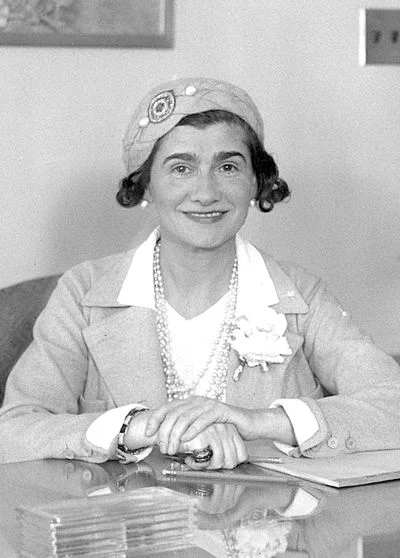
Liberated women's fashion: Chanel's little black dress, forever iconic.
Conversation Starters
Life Journey
Gabrielle Bonheur Chanel was born in a poorhouse hospice in Saumur to an unmarried laundrywoman. Her birth certificate would be falsified multiple times throughout her life as she invented more glamorous origins to escape her humble beginnings.
After her mother died of tuberculosis, Chanel's father abandoned her to the strict nuns of the Aubazine orphanage. The austere convent environment—with its black and white interiors and simple uniforms—would profoundly influence her minimalist aesthetic.
Chanel left the orphanage at eighteen and found work as a seamstress in a tailor's shop. By night she performed as a café singer, earning the nickname 'Coco' from the songs she sang, launching her double life in society and entertainment.
Chanel became the mistress of textile heir Étienne Balsan, living on his estate and learning the ways of aristocratic society. She began making hats for Balsan's socialite friends, discovering her talent for design and her appetite for independence.
With financial backing from her new lover Arthur 'Boy' Capel, Chanel opened her first millinery shop on rue Cambon in Paris. Her simple, elegant hats stood in stark contrast to the elaborate creations of the era, attracting fashionable Parisian women.
Chanel opened a boutique in the fashionable resort town of Deauville, selling sportswear and clothing that freed women from the corsets of the Belle Époque. Her practical designs resonated with modern women seeking comfort without sacrificing elegance.
Chanel introduced jersey fabric—previously used only for men's underwear—into women's fashion. Her comfortable, practical designs during World War I liberated women from heavy, restrictive clothing and established her as a revolutionary force in fashion.
Arthur Capel, the great love of Chanel's life and her business mentor, died in a car accident. Devastated, Chanel painted the walls of her bedroom black. She never married, later saying 'His death was a terrible blow to me. In losing Capel, I lost everything.'
Chanel launched Chanel No. 5, created with perfumer Ernest Beaux. The revolutionary scent was the first to use synthetic aldehydes, creating an abstract floral bouquet. Its iconic minimalist bottle and name challenged perfume conventions and became the world's best-selling fragrance.
Chanel introduced the 'little black dress' in American Vogue, which called it 'Chanel's Ford'—a garment that would become universal. Previously associated with mourning, black became the color of chic elegance, democratizing fashion and establishing an enduring wardrobe essential.
Samuel Goldwyn invited Chanel to Hollywood to dress MGM's biggest stars at a million-dollar contract. Though the venture was not entirely successful, it exposed her designs to American audiences and cemented her international celebrity status.
Chanel's fashion empire employed 4,000 workers and produced 28,000 garments annually. She had become one of the richest women in France, her influence extending from fashion to jewelry, textiles, and perfume, while her personal style defined an era.
With the outbreak of World War II, Chanel closed her couture house, dismissing her workers. She would later claim it was inappropriate to dress women during wartime, though business considerations and personal circumstances also played a role.
At the liberation of Paris, Chanel was briefly arrested for her relationship with German officer Hans Günther von Dincklage and suspected collaboration. Released thanks to influential friends, she fled to Switzerland, where she would live in exile for nearly a decade.
At age 71, Chanel reopened her couture house, declaring Christian Dior's 'New Look' ridiculous and impractical. Though French critics were hostile, American buyers and press embraced her practical, elegant designs, and within years she had recaptured her position at fashion's summit.
The Chanel suit—a collarless cardigan jacket with braided trim and knee-length skirt—became the defining silhouette of the era. Worn by Jacqueline Kennedy and copied worldwide, it represented Chanel's philosophy of timeless, comfortable elegance.
In her eighties, Chanel continued to work with furious energy, personally fitting every garment. Her clients included Elizabeth Taylor, Grace Kelly, and the Duchess of Windsor. She lived at the Ritz and walked daily to her atelier across rue Cambon.
Coco Chanel died in her suite at the Ritz Paris on a Sunday evening, reportedly saying 'This is how one dies.' She was buried in Lausanne, Switzerland. Her fashion house would later become one of the world's most valuable luxury brands, her legacy an eternal symbol of French elegance.