Quick Facts
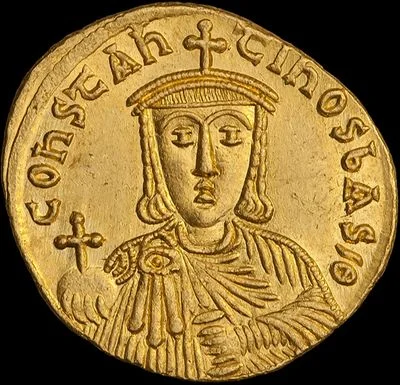
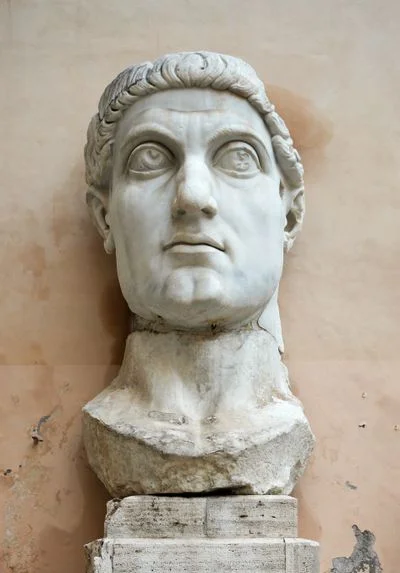
Constantine: United Rome, legalized Christianity, built Constantinople: new Rome.
Conversation Starters
Life Journey
Flavius Valerius Constantinus was born in Naissus to Constantius Chlorus, a Roman military officer, and Helena, a woman of humble origins. His birth during the Crisis of the Third Century shaped his destiny as a future emperor.
Young Constantine was sent to the court of Emperor Diocletian in Nicomedia, where he received education in Latin, Greek, philosophy, and military strategy. He served as a hostage guaranteeing his father's loyalty to the tetrarchy.
Constantine served with distinction in Emperor Diocletian's campaigns against the Persians and later with Galerius on the Danube frontier. These experiences honed his military skills and gave him firsthand knowledge of imperial administration.
After Diocletian's abdication, Constantine feared for his safety under Galerius. He dramatically escaped eastward, reportedly maiming post horses behind him to prevent pursuit, and joined his father Constantius Chlorus in Gaul.
When Constantius Chlorus died at York, the legions immediately proclaimed Constantine as Augustus. This act defied the tetrarchic system and launched Constantine on his path to sole rule, though it took years of civil war to achieve.
Constantine married Fausta, cementing an alliance with her father, the former emperor Maximian. The marriage produced three sons who would become emperors. The union later ended tragically when Constantine ordered Fausta's execution in 326.
Constantine defeated his rival Maxentius at the Milvian Bridge outside Rome. Before the battle, he reportedly saw a vision of the Christian cross with the words 'In this sign, conquer.' This victory made him master of the Western Empire.
Constantine and his co-emperor Licinius issued the Edict of Milan, granting Christians and all others freedom of worship. This landmark decree ended official persecution and began the transformation of Christianity from a persecuted sect to the dominant religion of Rome.
Constantine convened the Council of Arles to resolve the Donatist schism in North Africa. This was his first major intervention in church affairs, establishing the precedent that emperors would involve themselves in resolving Christian theological disputes.
After years of tension, Constantine defeated his last rival Licinius at the Battle of Chrysopolis. For the first time in decades, the Roman Empire was reunited under a single ruler. Constantine executed Licinius the following year despite promising him mercy.
Constantine personally convened and presided over the First Ecumenical Council at Nicaea to address the Arian controversy. The council produced the Nicene Creed, establishing orthodox Christian doctrine on the nature of Christ that remains foundational today.
In a mysterious family tragedy, Constantine ordered the execution of his eldest son Crispus, followed shortly by his wife Fausta. The exact reasons remain unclear, with ancient sources suggesting accusations of adultery or conspiracy. The events haunted Constantine's later years.
Constantine formally dedicated his new capital, Constantinople, built on the site of ancient Byzantium. The city featured Christian churches, classical monuments, and the imperial palace. It would serve as the capital of the Eastern Roman Empire for over a millennium.
Constantine achieved a decisive victory over the Goths who had been raiding Roman territory. He killed their king and took many prisoners, temporarily stabilizing the Danube frontier. The victory demonstrated that the aging emperor remained a formidable military commander.
Constantine divided the empire among his three sons and two nephews, planning for succession after his death. This arrangement would lead to civil war after his death, as his heirs fought for supremacy, but it reflected his hope for dynastic continuity.
Constantine fell ill and was baptized by Bishop Eusebius of Nicomedia shortly before his death on May 22, 337. He had delayed baptism until near death, as was common practice. He was buried in the Church of the Holy Apostles in Constantinople, which he had built for this purpose.