Quick Facts
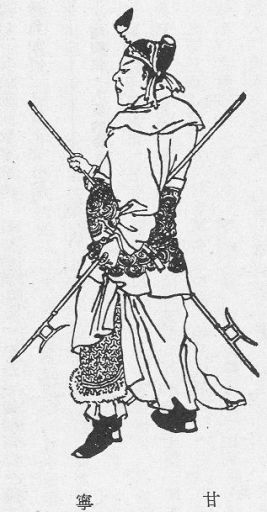
A fearless river raider turned famed Wu admiral, celebrated for bold night assaults and uncompromising loyalty.
Conversation Starters
Life Journey
Born in Linjiang Commandery in the late Eastern Han, he grew up amid busy Yangtze River trade routes and local militias. The region's waterways and violent frontier politics shaped his skills with boats, weapons, and men.
As a young man he gathered followers and turned to raiding along the Yangtze, using fast boats and intimidation to control stretches of river traffic. His reputation spread through Jing Province as both dangerous and unusually disciplined for an outlaw.
Tiring of outlaw life, he tried to enter formal service under provincial authorities and local administrators in Jing Province. The transition was uneasy, but it showed his ambition to convert battlefield skill into recognized rank and security.
He moved through the circles of Governor Liu Biao, whose court in Xiangyang balanced warlords, scholars, and powerful clans. In this environment, Gan Ning’s blunt, martial style clashed with more cautious officials and limited his advancement.
He attached himself to Huang Zu, a senior commander guarding key river approaches, hoping for promotion through merit. Huang Zu distrusted his past and kept him underused, a slight that pushed Gan Ning to look for a bolder patron.
He left Huang Zu’s camp and entered the service of Sun Quan, the rising ruler of Jiangdong, bringing followers and hard-won river combat experience. Sun Quan valued talent over pedigree and gave him opportunities that other courts denied.
During Sun Quan’s push to seize Jiangxia, Gan Ning helped drive the assault that removed Huang Zu and opened strategic river corridors. The victory strengthened Wu’s grip on the middle Yangtze and elevated Gan Ning as a proven commander.
As Wu expanded influence after Red Cliffs, he received postings that relied on controlling docks, patrol routes, and fortified crossings. His leadership emphasized speed, surprise, and strict discipline, turning former bandit methods into state strategy.
As tensions with Liu Bei’s forces rose over Jing Province, Gan Ning took part in securing Wu’s river defenses and supply lines. The contested frontier demanded commanders comfortable with raids and ambushes, roles that fit his temperament perfectly.
Wu launched attacks toward Hefei to test Cao Cao’s northern defenses, and Gan Ning served among the field commanders. The campaign highlighted the difficulty of storming well-led fortresses and set the stage for a daring raid that made his name.
Facing Zhang Liao’s Wei forces near Xiaoyao Ford, he volunteered for a risky night assault and struck the enemy camp with a small picked unit. The sudden attack rattled Wei morale and showcased Wu’s taste for audacity under Sun Quan’s command.
After Hefei, his standing rose as soldiers admired his willingness to share danger and reward merit. Court politics still favored older elites, but Sun Quan increasingly relied on him for operations needing nerve, speed, and river expertise.
He became known for a striking personal style, yet enforced order in camp and punished theft and disorder among his men. This mix of showmanship and discipline helped convert rough followers into reliable troops for sustained state warfare.
When Wu moved against Guan Yu’s overstretched positions, Gan Ning contributed to the broader effort of cutting communications and controlling river crossings. The episode reshaped the Three Kingdoms balance and hardened Wu’s hold along the Yangtze.
With Cao Pi founding Wei and Liu Bei building Shu, Wu’s commanders prepared for a long, three-sided struggle. Gan Ning remained a valuable specialist for patrols, raids, and rapid reinforcement along contested waterways and forts.
After a career marked by relentless campaigning and rough living, he died while still tied to Wu’s military frontier. His death removed one of Sun Quan’s boldest strike leaders, later memorialized for turning outlaw daring into loyal service.