Chumi
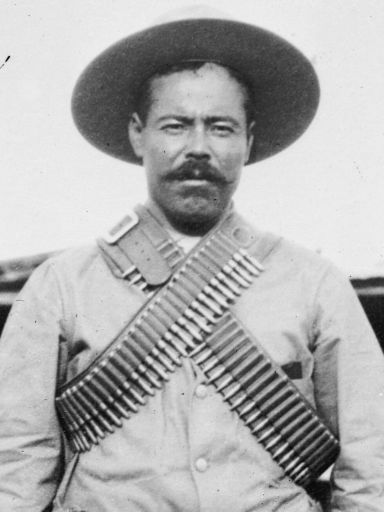
Francisco Pancho Villa

Francisco Pancho Villa

Revolutionary

Start Chat

AI Personality

Quick Facts

Commanding the División del Norte
Victory at the Battle of Zacatecas
1916 Columbus, New Mexico raid

Life Journey

1878Born as Doroteo Arango in San Juan del Río

Doroteo Arango was born into a poor peasant family in the state of Durango under Porfirio Díaz’s long dictatorship. Rural inequality and debt peonage in northern haciendas shaped the world he grew up in.

1894Fled after retaliating against a hacienda owner

After a family crisis involving a local hacendado, Arango became a fugitive and drifted into outlaw life in northern Mexico. He learned horsemanship, survival, and small-unit violence that later informed his military style.

1902Adopted the name "Pancho Villa" in the Sierra Madre

In the rugged borderlands, he began operating under the name Pancho Villa, building a reputation as a daring horseman and band leader. Local legends, corridos, and fear of rurales helped spread his notoriety across Chihuahua and Durango.

1910Joined the anti-Díaz revolt inspired by Francisco I. Madero

When Francisco I. Madero called for rebellion against Porfirio Díaz, Villa aligned with revolutionary forces in the north. He fought alongside Pascual Orozco’s insurgents and quickly proved valuable in mobile raids and ambushes.

1911Helped capture Ciudad Juárez, pressuring Díaz to resign

Revolutionary victories around Ciudad Juárez forced negotiations that led to Porfirio Díaz’s resignation and exile. Villa’s role boosted his status among northern fighters as Mexico transitioned into an unstable post-Díaz order.

1912Served under Victoriano Huerta and narrowly escaped execution

During the campaign against Pascual Orozco’s rebellion, Villa served under General Victoriano Huerta but clashed with him repeatedly. Arrested on disputed charges, Villa avoided a firing squad and escaped imprisonment, deepening his hatred of Huerta.

1913Returned to fight Huerta after Madero’s assassination

After the Ten Tragic Days coup in Mexico City and the murder of Madero, Villa joined Venustiano Carranza’s Constitutionalist movement. He rebuilt forces in Chihuahua, presenting himself as a defender of the revolution against Huerta’s regime.

1913Formed the División del Norte and expanded with rail logistics

Villa organized the División del Norte, combining cavalry shock tactics with captured railways and artillery. He recruited miners, ranch hands, and deserters, turning northern grievances into a disciplined army that could seize cities rapidly.

1914Won the Battle of Torreón, a major northern breakthrough

At Torreón, Villa’s forces defeated federal troops and captured supplies that strengthened his momentum. The victory showcased coordinated assaults, rail mobility, and propaganda that framed him as a champion of the poor in the north.

1914Captured Zacatecas in a decisive, bloody battle

Villa’s assault on Zacatecas shattered Huerta’s strategic position and hastened the dictator’s fall. The battle was brutal, with heavy casualties and fierce urban fighting, cementing Villa’s image as both liberator and ruthless commander.

1914Broke with Carranza after the Convention of Aguascalientes

Revolutionary leaders met at the Convention of Aguascalientes to settle power after Huerta’s defeat, but divisions intensified. Villa rejected Carranza’s authority and aligned with Emiliano Zapata, setting the stage for civil war among revolutionaries.

1914Entered Mexico City with Zapata’s forces

Villa and Zapata entered the capital in a dramatic but uneasy alliance, symbolizing popular revolt against elite rule. Despite the spectacle and photographs, they struggled to govern, and Carranza’s forces regrouped under Álvaro Obregón.

1915Suffered crushing defeats by Álvaro Obregón at Celaya

At Celaya, Obregón used trenches, barbed wire, and machine guns to blunt Villa’s cavalry charges in a new style of industrial warfare. The defeats crippled the División del Norte and shifted national momentum toward Carranza’s faction.

1916Raided Columbus, New Mexico, provoking U.S. retaliation

Villa attacked Columbus, New Mexico, killing civilians and soldiers while seeking supplies and political leverage. President Woodrow Wilson ordered the Punitive Expedition under General John J. Pershing, but U.S. forces failed to capture Villa.

1916Evaded Pershing during the Punitive Expedition in Chihuahua

Villa’s small bands used mountains, desert routes, and local support networks to avoid U.S. columns and scouts. Skirmishes and intelligence failures embarrassed both governments and further militarized the U.S.–Mexico border.

1920Accepted amnesty after Carranza’s fall and retired to Canutillo

After Carranza was overthrown, interim authorities negotiated Villa’s surrender to reduce ongoing northern conflict. Villa received the Hacienda de Canutillo and sought semi-retirement, maintaining a guarded entourage amid lingering enemies.

1923Assassinated while traveling through Parral

Villa was ambushed and shot repeatedly while riding in an automobile through Parral, ending his turbulent public life. The killing was widely seen as politically motivated, reflecting fear of his influence during the Obregón–Calles era.

Chat