Quick Facts
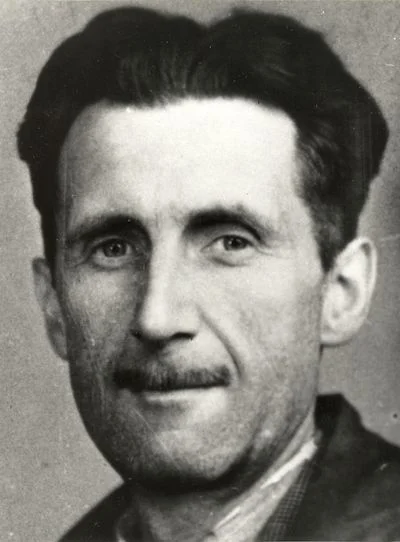
Big Brother is watching": Orwell, prophet of dystopia, warned us all.
Conversation Starters
Life Journey
Eric Arthur Blair was born to Richard Blair, a civil servant in the Opium Department of British India, and Ida Mabel Blair. The family's modest gentility—what Orwell called 'lower-upper-middle class'—shaped his acute awareness of English class distinctions.
Orwell's mother brought him to England, where he grew up barely knowing his father, who remained in India. This separation and his mother's struggles to maintain respectability on limited income gave him early insight into the strains of genteel poverty.
Orwell attended St. Cyprian's preparatory school on reduced fees, an arrangement that made him feel stigmatized. His essay 'Such, Such Were the Joys' later described the humiliations and snobbery he experienced there, forming his critique of British education.
Orwell won a King's Scholarship to Eton, England's most prestigious school. He was an indifferent student but read widely, developed his independent thinking, and formed friendships with future intellectuals including Cyril Connolly.
Rather than attend university, Orwell joined the Indian Imperial Police in Burma. His five years there gave him firsthand experience of imperialism's brutality and corruption, transforming him into a critic of empire and all forms of authoritarian power.
Orwell resigned from the Imperial Police, determined to become a writer and atone for his role in imperialism. He later wrote: 'I was conscious of an immense weight of guilt I had got to expiate.' His Burmese experiences inspired his first novel.
Orwell moved to Paris to write, living in working-class districts and experiencing poverty firsthand when his money was stolen. He worked as a plongeur (dishwasher) in hotel kitchens, gathering material for 'Down and Out in Paris and London.'
Orwell worked as a schoolteacher in private schools while writing. The experience informed 'A Clergyman's Daughter' and deepened his observation of English class structure and the struggles of educated people without money.
Orwell's first book appeared under his pen name George Orwell, which he adopted to protect his family from association with its subject matter. The documentary account of poverty established his style of combining personal experience with social analysis.
Commissioned by the Left Book Club, Orwell spent months in industrial northern England documenting working-class life during the Depression. The resulting book combined vivid reportage with provocative critique of middle-class socialists, angering his publishers.
Orwell married Eileen O'Shaughnessy, a psychology graduate who would support his writing and share his political commitments. The marriage proved a genuine partnership despite poverty, war, and Orwell's poor health.
Orwell traveled to Spain to fight against fascism, joining the POUM militia on the Aragon front. He was shot through the throat by a sniper but survived, only to witness the Communist suppression of his party that radicalized his anti-Stalinist politics.
Orwell's account of the Spanish Civil War exposed Communist betrayal of the revolution and documented his own near-death and the persecution of fellow fighters. The book sold poorly but established his critique of totalitarian Stalinism.
Orwell completed his satirical fable of the Russian Revolution, but publishers refused it while the Soviet Union was a British ally. When finally published in 1945, it became an international bestseller that made Orwell famous and financially secure.
Eileen died unexpectedly during surgery, leaving Orwell devastated and alone with an adopted infant son. He threw himself into journalism and began his final novel while his tuberculosis worsened, racing against declining health.
Despite severe tuberculosis, Orwell finished his dystopian masterpiece on the remote Scottish island of Jura. The novel's vision of totalitarian control—Big Brother, Newspeak, the Thought Police—became defining imagery of the twentieth century.
Orwell died of tuberculosis in University College Hospital, London, shortly after marrying Sonia Brownell. He was buried under his real name, Eric Arthur Blair. His work defined political clarity as a moral imperative, coining terms still used to describe authoritarian abuse.