Quick Facts
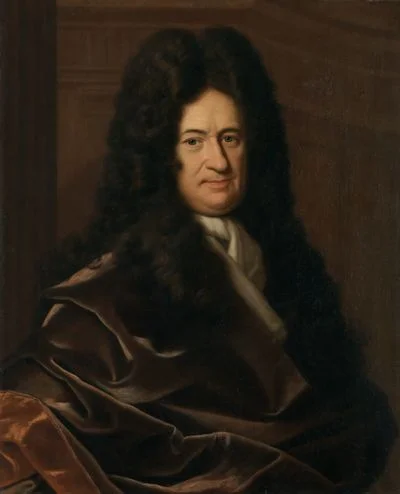
Invented calculus (separately from Newton). Polymath who saw the universe in binary code.
Conversation Starters
Life Journey
Gottfried Wilhelm Leibniz was born to Friedrich Leibniz, a professor of moral philosophy, and Catharina Schmuck.
After his father's death, young Leibniz gained access to his extensive library, sparking his lifelong love of learning.
Leibniz enrolled at the University of Leipzig to study philosophy and law, showing exceptional academic ability.
Leibniz received his doctorate in law from the University of Altdorf, declining a professorship to pursue other interests.
Leibniz entered the service of Johann Philipp von Schonborn, working on legal reform and diplomatic missions.
Leibniz traveled to Paris on a diplomatic mission, where he remained for four years studying mathematics and philosophy.
Leibniz invented the Stepped Reckoner, a mechanical calculator capable of multiplication and division.
Leibniz independently developed infinitesimal calculus, introducing notation still used today including the integral sign.
Leibniz accepted position as librarian and court counselor to Duke Johann Friedrich in Hanover.
Leibniz published Nova Methodus pro Maximis et Minimis, introducing differential calculus to the scientific world.
Leibniz wrote Discourse on Metaphysics, outlining his philosophical system including the concept of monads.
Leibniz introduced the concept of vis viva (living force), precursor to kinetic energy in modern physics.
Leibniz founded and became first president of the Berlin Academy of Sciences, promoting scientific research.
Leibniz wrote Monadology, his mature philosophical work describing the universe as composed of simple substances.
Leibniz died in Hanover largely forgotten, his funeral attended by his secretary alone despite his enormous contributions.