Quick Facts
A restless Silla Buddhist monk who trekked across Asia, leaving a rare eyewitness travel record of the Silk Roads.
Conversation Starters
Life Journey
Hyecho was born in the Korean kingdom of Silla, a period when Buddhism shaped court culture and education. His early environment likely included monastic learning and stories of foreign pilgrimage routes leading toward Tang China and India.
As a young teen, he entered Buddhist monastic life, learning sutras, discipline, and ritual practice common in Silla temples. The cosmopolitan prestige of Tang Buddhism helped kindle ambitions for study beyond the peninsula.
He immersed himself in Chinese-language scriptures and reports by earlier pilgrims, using them as practical guides to distant regions. These readings framed India as the sacred homeland of Buddhism and a destination worthy of extreme risk.
Hyecho left the Silla homeland and traveled to Tang territory, joining a flow of students and monks seeking advanced learning. Maritime and overland routes linked the peninsula to Tang ports and capitals despite storms, pirates, and banditry.
In Chang'an, he encountered a dense network of monasteries, translators, and foreign visitors from across Asia. The capital’s international atmosphere exposed him to debates on doctrine and to travelers who knew the western regions firsthand.
He came into the orbit of Vajrabodhi, a famed Indian esoteric Buddhist master active in Tang China. Training in mantra and ritual practice expanded Hyecho’s horizons and connected him to trans-Asian networks of disciples and patrons.
Inspired by Indian teachers and earlier pilgrim legends, he committed to seeing Buddhist holy sites directly. Planning required securing travel documents, sponsors, and safe passage across frontier zones contested by Tang, Tibet, and local rulers.
Hyecho began a westward journey through the Hexi Corridor, where garrisons, oasis towns, and caravan trade supported long-distance travel. The route demanded constant negotiation with local officials, guides, and merchants for protection and supplies.
He moved among oasis states where languages, scripts, and religions mixed, including Buddhism, local cults, and growing Islamic influences farther west. His notes emphasized political control, taxation, and the lived condition of monasteries and laypeople.
Passing through regions contested by Tang influence, Tibetan expansion, and Turkic elites, he observed unstable frontier governance. He recorded practical details about rulers, currencies, and customs, highlighting how politics shaped religious life and travel safety.
Hyecho approached India through the northwest, a gateway shaped by old Buddhist centers and newer regional kingdoms. He noted climate, food, and social customs that differed sharply from Tang and Silla, treating them as evidence for future pilgrims.
He sought renowned holy places tied to the Buddha’s life and to famous monasteries, assessing their prosperity and decline. His observations stressed the real condition of temples, the presence of non-Buddhist groups, and the challenges of patronage.
He gathered geographic and political notes that later formed the backbone of his travelogue, comparing multiple Indian regions in a systematic way. Rather than legend, he emphasized current rulers, roads, languages, and the practicalities of survival on route.
After years of travel, he turned back toward the north and west, retracing dangerous corridors where control could change between seasons. His account reflects the constant need to assess security, caravan timing, and the hospitality of local authorities.
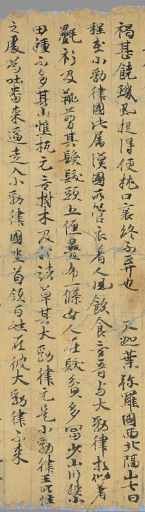
Back in Tang domains, he wrote a concise, information-rich travel record in Chinese for learned readers and future pilgrims. The work captured a rare 8th-century snapshot of Central and South Asia, blending religious purpose with ethnographic detail.
His report moved within Buddhist communities that valued accurate route knowledge, temple conditions, and political realities. The text’s practical tone suggests it was intended as a usable guide rather than a courtly memoir or purely devotional narrative.
In his later years, he likely continued as a monk within Tang monasteries, where foreign-born clerics could contribute language skills and firsthand geographic knowledge. His travel experience would have made him a valued informant for students contemplating pilgrimage.
Hyecho’s death is not securely dated, and later records preserved only fragments of his life. His travelogue survived precariously and became far more celebrated in modern scholarship for its unmatched on-the-ground view of Silk Road societies.