Quick Facts
Brilliant Buddhist translator-monk who reshaped Chinese Buddhism through lucid sutra renditions, rigorous scholarship, and cross-cultural diplomacy.
Conversation Starters
Life Journey
Born in Kucha, a major oasis state on the northern Silk Road, he grew up amid Indian, Iranian, and Chinese influences. His father was an Indian Brahmin said to have become a monk, and his mother was a Kuchean princess devoted to Buddhism.
As a child he entered the Buddhist monastic community, traveling with his mother and studying basic scriptures and discipline. Their journeys through Central Asian monasteries exposed him early to competing schools and multilingual teaching traditions.
He trained in scholastic Buddhism, learning Abhidharma categories and the Vinaya rules that structured monastic life. Teachers in Kucha emphasized memorization and debate, skills that later shaped his precise, pedagogical translation style.
He and his mother journeyed toward Kashmir, then a renowned center for Buddhist learning and Sanskrit scholarship. The route along the Pamirs connected monasteries that preserved Indian texts and trained monks for long-distance teaching missions.
In Kashmir he studied with leading scholars, deepening his command of Sanskrit and doctrinal argumentation. Exposure to refined commentarial traditions helped him later render complex Indian philosophy into clear, forceful Chinese prose.
While trained in earlier scholastic systems, he embraced Mahayana sutras and the philosophical depth of the Middle Way. Teachers and patrons along the Silk Road encouraged him to reconcile rigorous analysis with compassion-centered bodhisattva ideals.
He came back to Kucha with a reputation for sharp debate and broad learning, attracting monks and lay patrons. Kucha's cosmopolitan court and monasteries provided a platform to lecture on Mahayana doctrine to mixed Central Asian audiences.
He expounded Madhyamaka arguments on emptiness and dependent origination, using debate formats familiar to Indian scholasticism. These teachings prepared him for later work translating Nagarjuna-related texts that became central to Chinese Sanlun thought.
The general Lu Guang seized Kucha during military expeditions tied to the Former Qin state's ambitions in Central Asia. Kumarajiva was taken east as a prized scholar, and the upheaval disrupted the monastic networks that had supported his teaching.
After the Former Qin collapsed, Lu Guang controlled the Hexi corridor and kept Kumarajiva in Wuwei for years. Despite confinement, he taught and refined his linguistic skills, preparing for the larger translation work that would later follow.
Yao Xing of the Later Qin secured his transfer to Chang'an, viewing him as essential for legitimizing rule through Buddhism. The capital's monasteries and scholars offered the resources to create a state-supported translation bureau on an unprecedented scale.
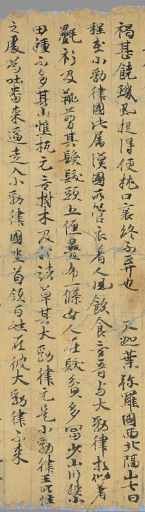
In Chang'an he led collaborative translations, dictating from Sanskrit while scribes and editors refined the Chinese under his supervision. Disciples such as Sengzhao participated in the process, helping standardize terminology and spread his doctrinal approach.
His translation of the Vimalakirti Sutra became famous for elegant phrasing and philosophical clarity suited to Chinese literary tastes. It inspired generations of monks and lay intellectuals by portraying a sharp-witted lay bodhisattva debating leading disciples.
He rendered major Prajnaparamita scriptures into readable Chinese, emphasizing emptiness and non-attachment without losing argumentative force. These texts became core study materials in monasteries and informed later Tiantai, Huayan, and Chan discussions.
His Chinese Lotus Sutra (Saddharmapundarika) translation gained enduring authority for its rhythmic style and doctrinal precision. The text became central to devotional practice and exegesis, especially for communities that later formed the Tiantai tradition.
His translation of the Amitabha Sutra helped popularize devotion to Amitabha Buddha and the aspiration for rebirth in Sukhavati. The concise, vivid Chinese wording supported chanting practices and doctrinal teaching among both monks and lay believers.
He advocated conveying intended meaning over overly literal word-for-word rendering, while still anchoring choices in Indian doctrinal context. This approach set a benchmark for later translators and helped make sophisticated Mahayana philosophy accessible in Chinese.
He died in Chang'an after overseeing a corpus that reshaped Chinese Buddhist language and doctrine. His translations and teaching lineage influenced scholastic debates and devotional practice for centuries, becoming standards cited across East Asian Buddhism.