Quick Facts
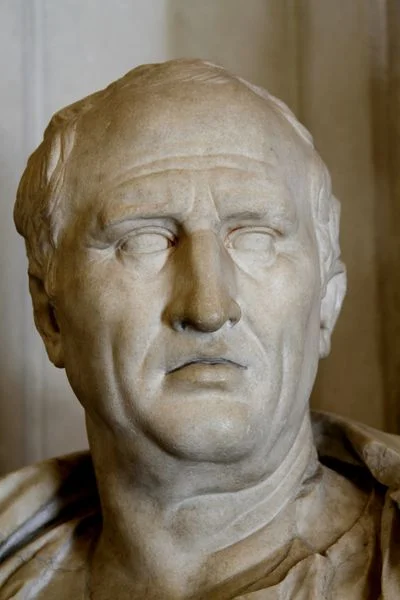
O tempora, o mores!" Cicero: Rome's eloquent voice, defender of republic.
Conversation Starters
Life Journey
Marcus Tullius Cicero was born into an equestrian family in the hill town of Arpinum, about 100 kilometers southeast of Rome. His family, though not of the senatorial class, was wealthy and well-connected, providing him opportunities for excellent education.
Cicero moved to Rome to begin his formal education, studying under the leading orators and jurists of the day. He quickly displayed exceptional talent in rhetoric and became fluent in Greek, the language of philosophy and higher learning.
Cicero delivered his first major legal defense in the case of Publius Quinctius, establishing his reputation as a skilled advocate. This case showcased his rhetorical abilities and launched his career as one of Rome's most sought-after lawyers.
Cicero successfully defended Sextus Roscius against charges of parricide in a politically charged case that challenged the powerful dictator Sulla's associates. This courageous defense brought him fame throughout Rome and established his reputation for taking on difficult cases.
Following the Roscius trial, Cicero traveled to Athens and Rhodes to study philosophy and perfect his oratorical skills. He studied under the Academic philosopher Antiochus of Ascalon and the Stoic Posidonius, experiences that deeply influenced his philosophical writings.
Cicero was elected quaestor and assigned to western Sicily, his first public office. He gained a reputation for honest administration that contrasted sharply with the corruption typical of Roman provincial governance.
Cicero was elected curule aedile, responsible for public games and temples. He began his famous prosecution of Verres, the corrupt governor of Sicily, showcasing his mastery of legal oratory.
Cicero was elected praetor, the highest judicial office below consul, with overwhelming support. He presided over the extortion court and delivered his speech 'Pro Lege Manilia' supporting Pompey's command against Mithridates.
Cicero achieved the consulship, the highest office in the Roman Republic, as a 'novus homo' (new man) - the first in his family to reach this rank. This was an extraordinary achievement for someone without senatorial ancestry.
As consul, Cicero exposed and crushed the conspiracy of Catiline to overthrow the Republic. His four famous orations against Catiline became models of Latin prose, and the Senate awarded him the title 'Pater Patriae' (Father of the Fatherland).
Cicero was forced into exile by his political enemy Clodius, who passed a law declaring him an outlaw for executing Catiline's conspirators without trial. He spent a miserable year in Macedonia, deeply depressed and longing for Rome.
Cicero returned to Rome after the Senate voted for his recall, greeted by jubilant crowds along his route. His property was restored, though his beloved house on the Palatine had been destroyed by Clodius.
Cicero reluctantly accepted the governorship of Cilicia in Asia Minor. He administered the province with unusual integrity, refused bribes, and even won a minor military victory. His letters from this period provide invaluable insights into Roman provincial administration.
Cicero's beloved daughter Tullia died shortly after childbirth, plunging him into profound grief. This personal tragedy led him to write philosophical consolations and retreat into literary work, producing some of his most important philosophical treatises.
Following Caesar's assassination, Cicero delivered his fourteen Philippics - powerful speeches attacking Mark Antony and defending the Republic. These orations, modeled on Demosthenes' speeches against Philip of Macedon, represented his final stand for republican government.
Cicero was proscribed by the Second Triumvirate and hunted down by Antony's soldiers near his villa at Formiae. He faced his executioners calmly, reportedly saying 'There is nothing proper about what you are doing, but at least make sure you cut off my head properly.' His head and hands were displayed on the Rostra in the Forum.