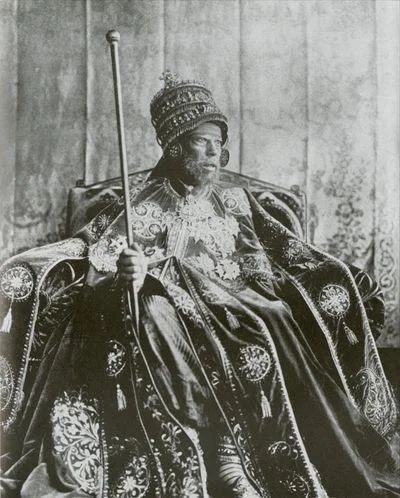
Quick Facts
At Adwa, Ethiopia crushed a European army. Africa could resist colonialism—Menelik proved it with blood, tactics, and sheer determination.
Conversation Starters
Life Journey
Menelik II was born to King Haile Melekot of Shewa and Woizero Abeba. He was named Sahle Selassie at birth.
Menelik II, along with his father, was captured by Emperor Tewodros II and held as a hostage in Magdala. His father died in captivity.
Menelik II managed to escape from Tewodros II's captivity and returned to Shewa, where he was proclaimed Negus (King) of Shewa.
Menelik II married Woizero Baffa, his first wife. This marriage was politically significant as it strengthened his alliances in the region.
Menelik II consolidated his power in Shewa and began to modernize the region, building roads, schools, and administrative structures.
Menelik II married Taytu Betul, a politically astute and influential woman who played a significant role in his reign.
Following the death of Emperor Yohannes IV, Menelik II was crowned Emperor of Ethiopia, assuming the name Menelik II and consolidating his power across the nation.
Menelik II signed the Treaty of Wuchale with Italy, which he later claimed was misinterpreted, leading to the Italian annexation of parts of Ethiopia.
Menelik II led Ethiopian forces to a decisive victory against Italian invaders at the Battle of Adwa, securing Ethiopia's independence and international recognition.
Menelik II officially declared Addis Ababa the capital of Ethiopia, transforming it into a modern city with infrastructure and institutions.
Menelik II continued to expand Ethiopia's territory, incorporating regions such as Harar, Kaffa, and Sidamo, and strengthening central authority.
Menelik II introduced a modern legal code, based on European models, to standardize laws and improve governance in Ethiopia.
Menelik II celebrated 20 years of his reign, marked by significant modernization, territorial expansion, and the strengthening of Ethiopian sovereignty.
Due to declining health, Menelik II began to withdraw from active rule, with power gradually shifting to his wife, Empress Taytu Betul, and other regents.
Menelik II died in Addis Ababa, leaving behind a legacy of modernization, national unity, and resistance to colonialism. He was succeeded by his grandson, Lij Iyasu.