Quick Facts
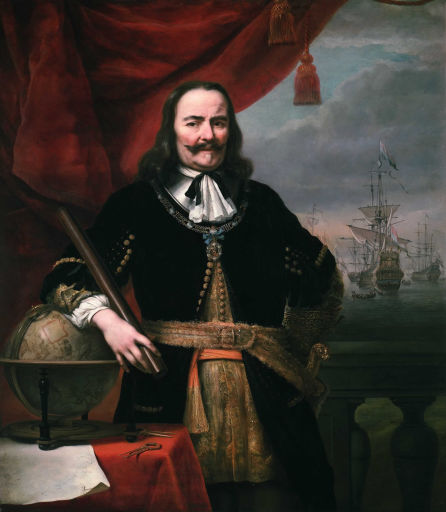
A brilliant Dutch admiral whose daring raids, disciplined seamanship, and tactical genius reshaped seventeenth-century naval warfare.
Conversation Starters
Life Journey
Born in Vlissingen in the Dutch Republic, a seafaring town shaped by the Eighty Years' War. His family was modest, and the sea offered both livelihood and danger in a nation fighting for independence.
As a boy he went to sea, learning ropes, navigation, and discipline aboard merchant vessels. The North Sea and Channel trade routes exposed him early to privateers and wartime disruption.
In his teens he joined armed voyages tied to the Dutch struggle against Habsburg Spain. The experience hardened his seamanship and introduced him to convoy protection and fleet coordination under fire.
He rose through merchant shipping where discipline and reliability determined survival and profit. Regular convoy duties against Dunkirk privateers strengthened his reputation among Dutch maritime merchants and officials.
He married Maayke Velder, anchoring his personal life amid constant voyages. Like many seafarers’ families, their household faced long separations and the uncertainty of war and storm.
After Maayke Velder’s death, he returned fully to maritime service and command opportunities. The loss deepened his seriousness and reinforced his focus on duty, discipline, and faith.
He married Neeltje Engels, building a new family while maintaining an intense sailing schedule. Domestic stability helped him pursue higher responsibility in the merchant marine and naval appointments.
By the early 1640s he captained ships carrying vital Dutch trade goods across contested waters. His careful convoy handling reduced losses and made him a trusted figure among Zeeland maritime circles.
When war with England erupted, he accepted a naval commission and quickly proved decisive in combat leadership. He helped rebuild confidence after setbacks, working under the States General and provincial admiralties.
During the brutal 1653 campaign, Dutch fleets fought desperate actions to protect trade and coasts. His steadiness and tactical sense stood out in an era of evolving line-of-battle doctrine and heavy gunnery.
After the war, he was promoted to Vice-Admiral, reflecting trust from the Zeeland Admiralty and the States General. He pushed for training, ship readiness, and disciplined formations to face England again.
With England threatening Dutch commerce, he emerged as the Republic’s principal sea commander. He balanced politics between Johan de Witt’s government and provincial interests while preparing fleets for major engagements.
In June 1666 he led Dutch forces in the Four Days' Battle, one of history’s longest naval engagements. Coordinating admirals and damaged squadrons, he outlasted the English and won a strategic victory.
In 1667 he spearheaded a daring strike up the River Medway, attacking England’s dockyards at Chatham. Dutch forces burned ships, captured HMS Royal Charles, and shocked London into peace negotiations.
When France and England attacked in 1672, the Dutch Republic faced existential danger during the Rampjaar. He fought to keep sea lanes open, protecting the coastline while political power shifted to William III.
In 1673 he helped prevent an English-French landing by fighting hard actions near the Dutch coast. The culminating Battle of Texel preserved Dutch independence by denying the invaders decisive control of the sea.
Commanding a Dutch squadron in Mediterranean operations, he fought French forces in the Battle of Agosta off Sicily. He was severely wounded by cannon fire, and his leadership remained calm despite failing health.
He died from his injuries shortly after being brought to port, ending a career that embodied Dutch maritime power. The Dutch Republic honored him with a grand funeral in Amsterdam’s Nieuwe Kerk, befitting a national hero.