Quick Facts
A disciplined French painter who shaped Baroque classicism through learned mythologies, moral clarity, and rigorously ordered compositions.
Conversation Starters
Life Journey
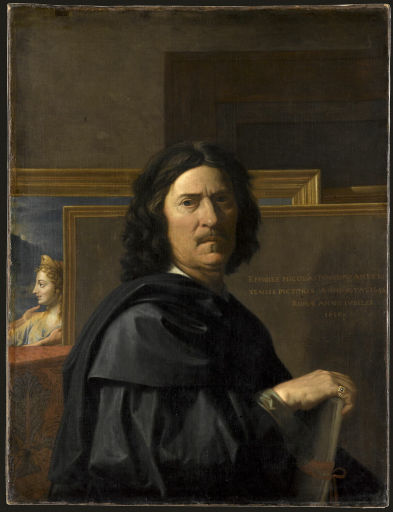
Nicolas Poussin was born in Les Andelys in Normandy, in the Kingdom of France. Growing up far from court, he developed an early fascination with drawing and the stories of antiquity that later shaped his learned art.
As a teenager he moved to Paris to seek commissions and instruction among the city’s workshops. The capital exposed him to prints after Raphael and classical subjects, pushing him toward ambitious history painting rather than portraiture.
Poussin tried to travel to Rome, the artistic center of Catholic Europe, but early efforts were delayed by money and patronage problems. These setbacks hardened his resolve to study ancient art firsthand and escape Parisian factional tastes.
He finally settled in Rome, where ruins, sculptures, and Vatican collections offered a living school of antiquity. He studied Raphael and Titian while sketching ancient reliefs, aiming for clarity, order, and philosophical seriousness.
In Rome he attracted cultivated supporters among French and Italian elites, including antiquarians and churchmen. Their libraries and discussions encouraged him to paint complex myths and biblical narratives with precise iconography and moral intent.
Poussin married Anne-Marie Dughet, sister of the painter Gaspard Dughet, creating a close-knit Roman family circle. The marriage brought stability and allowed him to work methodically, pursuing commissions without relying on court life.
By the early 1630s his reputation rose through large narrative paintings for prominent patrons in Rome. He refined a distinctive classicist language—balanced figures, legible gestures, and controlled emotion—suited to erudite collectors.
Cardinal Richelieu and the French court called him back, expecting him to guide royal artistic projects. In Paris he faced rivalry and bureaucracy around the Bâtiments du Roi, which clashed with his preference for quiet, independent work.
He accepted the title of Premier Peintre du Roi and produced designs and paintings for royal decoration. The demands of committees and shifting tastes frustrated him, reinforcing his belief that great art required solitude and study.
After Richelieu died in 1642, Poussin used the political change to leave France and resettle in Rome. He chose a life among antiquities and connoisseurs, where he could control his subjects, scale, and working rhythm.
From Rome he supplied paintings to patrons across France and beyond, often through correspondence and careful planning. His studio practice emphasized drawings and small compositional models, aiming for narrative logic and measured feeling.
In the late 1640s he increasingly integrated landscape with history, making nature a stage for human virtue and tragedy. These works helped define the “ideal landscape,” admired by later painters for structure, light, and poetic restraint.
His Arcadian subjects explored mortality and memory through classical shepherds and tomb inscriptions. The calm arrangement and sober tone expressed a stoic meditation on death, aligning painting with philosophy and learned conversation.
As he aged, he suffered tremors and fatigue that made large canvases harder to execute. He adapted by focusing on carefully planned compositions and drawings, maintaining precision even as physical strength diminished.
His final decade produced concentrated, austere works in which gesture and architecture carry the story. Collectors valued their intellectual rigor, and younger artists studied them as models of how to balance passion with reason.
Poussin died in Rome after decades of work that linked French taste to the legacy of antiquity. He was buried with respect in the city he chose, and his classicism later became central to academic art in France.