Quick Facts
Russia reborn: Peter's iron will forged a modern empire.
Conversation Starters
Life Journey
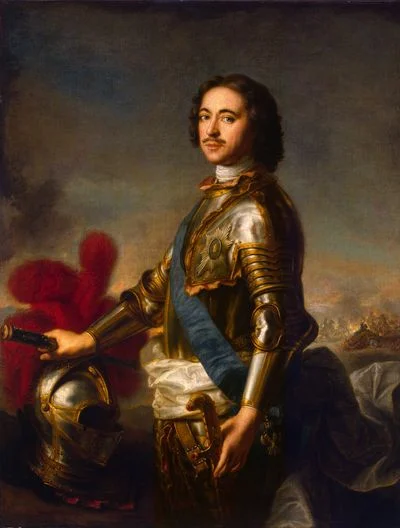
Peter Alexeyevich was born to Tsar Alexis I and his second wife Natalya Naryshkina. As the fourteenth child of Alexis, Peter was not expected to rule, but fate would make him one of history's most transformative monarchs.
Following a violent succession crisis, Peter was proclaimed co-tsar alongside his sickly half-brother Ivan V, with their sister Sophia serving as regent. Peter spent these years away from court, developing his passion for military games and Western technology.
Peter overthrew his sister Sophia's regency with the help of loyal guards regiments. Though Ivan V remained nominal co-tsar until his death in 1696, Peter now held real power and began planning Russia's transformation.
Peter launched his first military campaign against the Ottoman fortress of Azov. Though initially unsuccessful, he built Russia's first navy and captured Azov in 1696, gaining access to the Black Sea.
Peter traveled incognito through Western Europe on the Grand Embassy, working as a shipwright in Dutch and English shipyards. He studied Western technology, military organization, and governance, recruiting hundreds of experts to modernize Russia.
Peter returned from Europe to crush a rebellion by the Streltsy guards. He personally participated in the torture and execution of rebels, disbanded the Streltsy, and began forcing Russian nobles to adopt Western dress and shave their beards.
Peter declared war on Sweden to gain access to the Baltic Sea. The initial disaster at Narva, where Charles XII destroyed the Russian army, only strengthened Peter's determination to modernize his military.
Peter founded St. Petersburg on conquered Swedish territory at the mouth of the Neva River. Built on swampland at enormous human cost, the city became Russia's 'Window to the West' and new capital.
Peter won a decisive victory over Charles XII of Sweden at Poltava, destroying Swedish military power. This battle established Russia as a major European power and secured Peter's Baltic conquests.
Peter's campaign against the Ottoman Empire ended in disaster when his army was surrounded at the Pruth River. He was forced to return Azov and abandon his Black Sea ambitions, a rare major defeat.
Peter officially married his mistress Catherine, a Lithuanian peasant who had been captured in war. She became his trusted companion and advisor, and would succeed him as Empress Catherine I.
Following victory in the Great Northern War, Peter was proclaimed Emperor of All Russia by the Senate. The Treaty of Nystad gave Russia control of the Baltic coast, and Peter had transformed Russia into a European great power.
Peter established the Table of Ranks, reorganizing Russian society based on state service rather than birth. This meritocratic system allowed talented commoners to rise to nobility and modernized Russian administration.
Peter the Great died without naming an heir, reportedly after catching cold while rescuing drowning sailors. He left behind a transformed Russia: a European power with a modern army, navy, and bureaucracy, though at enormous human cost.