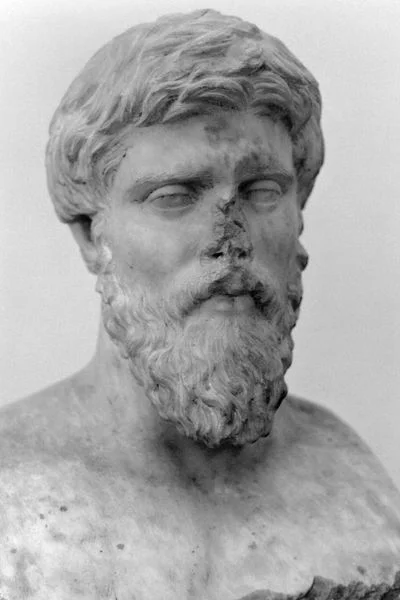
Quick Facts
He wrote the lives of heroes—comparing Greeks to Romans, exposing flaws alongside greatness. His biographies shaped how we see history.
Conversation Starters
Life Journey
Plutarch was born into a prominent family in Chaeronea, a town in the region of Boeotia, Greece.
Plutarch starts his formal education, likely focusing on literature, rhetoric, and philosophy, under the guidance of local scholars.
Plutarch travels to Athens to study philosophy and rhetoric, immersing himself in the intellectual life of the city.
After completing his studies in Athens, Plutarch returns to his hometown to begin his career as a teacher and public figure.
Plutarch is appointed as a priest at the Oracle of Delphi, a position that enhances his reputation and provides access to influential circles.
Plutarch marries Timoxena, with whom he will have several children, including at least one son, Autobulus.
Plutarch starts composing his 'Parallel Lives,' a series of biographies comparing Greek and Roman historical figures.
Plutarch publishes 'Moralia,' a collection of essays on ethical, political, and religious topics, which becomes highly influential.
Plutarch travels to Italy and Rome, where he continues his writing and gains recognition among Roman intellectuals.
While in Rome, Plutarch continues to write and expand his 'Parallel Lives,' further solidifying his reputation as a biographer.
Plutarch returns to Chaeronea, where he continues his work as a writer, teacher, and public figure, enjoying a period of great productivity.
Plutarch is elected to the Senate of Rome, a testament to his influence and reputation in the Roman Empire.
Plutarch completes his monumental work, 'Parallel Lives,' which consists of 22 biographical pairs and 4 single lives.
Plutarch retires from his public duties and focuses on writing and mentoring younger scholars in Chaeronea.
Plutarch dies in his hometown of Chaeronea, leaving behind a rich legacy of biographical and philosophical works that continue to influence literature and thought.