Quick Facts
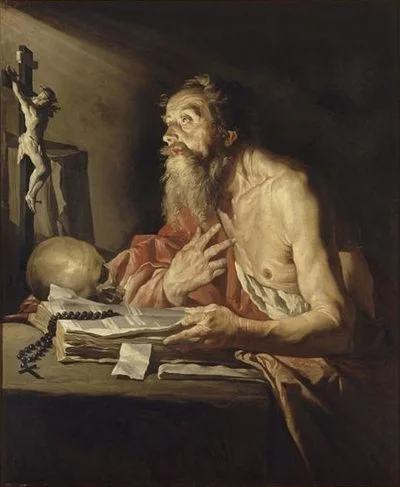
Vulgate's creator: Jerome shaped Christianity, translating Bible into Latin.
Conversation Starters
Life Journey
Eusebius Sophronius Hieronymus was born into a wealthy Christian family in the town of Stridon, on the border of Dalmatia and Pannonia. His parents provided him with an excellent education, laying the foundation for his future as one of the most learned men of antiquity. The exact location of Stridon remains uncertain, but was likely near modern Croatia or Slovenia.
Jerome's father sent him to Rome to study grammar under the famous teacher Aelius Donatus. He immersed himself in Latin literature, mastering Virgil, Cicero, and other classical authors. He also began learning Greek and developed a passionate love for books that would define his entire life.
After years of studying pagan literature, Jerome was baptized by Pope Liberius, marking his formal entry into the Christian faith. Though already attracted to Christianity, this moment represented a decisive spiritual commitment. He began exploring Christian texts alongside his beloved classical literature.
Jerome traveled to Trier in Gaul where he encountered monasticism for the first time. Deeply moved by the ascetic communities he witnessed, he began copying theological manuscripts and felt the first stirrings of his lifelong vocation to religious scholarship and the monastic life.
Seeking spiritual purification, Jerome withdrew to the barren desert of Chalcis, east of Antioch. For four years he lived as a hermit, fasting severely, studying Hebrew from a Jewish convert, and battling temptations. He described this period as one of extreme hardship but profound spiritual growth.
During a severe illness, Jerome experienced a vivid dream in which he was dragged before God's judgment seat. When he declared himself a Christian, a voice thundered, 'You lie! You are a Ciceronian, not a Christian!' He was flogged for his devotion to pagan literature and vowed to abandon secular books.
After leaving the desert, Jerome was ordained a priest by Bishop Paulinus of Antioch, though he never celebrated Mass and resisted pastoral duties. He preferred the life of a scholar-monk. During this time, he honed his Greek and began his career as a biblical commentator and translator.
Jerome traveled to Constantinople to study under Gregory Nazianzen, one of the greatest theologians of the Eastern Church. He deepened his knowledge of Greek Scripture and Eastern theological traditions. He also began translating Greek theological works into Latin, building his reputation as a scholar.
Jerome attended a council in Rome and so impressed Pope Damasus I that he was appointed papal secretary. The pope commissioned him to revise the existing Latin translations of the Gospels, beginning the monumental work that would become the Vulgate Bible. Jerome also became spiritual director to wealthy Roman women.
Paula's daughter Blesilla died after extreme fasting under Jerome's spiritual direction. Rome erupted in scandal, with critics blaming Jerome's harsh ascetic teachings. The tragedy damaged his reputation and contributed to his eventual departure from Rome. He defended himself vigorously but made many enemies.
After Pope Damasus died and Roman society turned hostile, Jerome left Rome forever, accompanied by his devoted followers Paula and Eustochium. They journeyed through the Holy Land and Egypt before settling in Bethlehem, where Jerome would spend the remaining thirty-five years of his life.
With Paula's wealth, Jerome established a monastery for men and three convents for women near the Church of the Nativity in Bethlehem. He also built a hospice for pilgrims. These institutions became centers of scholarship, prayer, and hospitality, attracting visitors from across the Christian world.
Breaking with tradition, Jerome began translating the Old Testament directly from Hebrew rather than from the Greek Septuagint. This revolutionary decision, influenced by his Jewish teachers, sparked controversy but produced a more accurate text. He worked methodically through each book over many years.
Jerome's former friend Rufinus accused him of hypocrisy for criticizing Origen while previously praising him. The resulting quarrel became one of the most vicious literary feuds of antiquity. Jerome's savage polemical skills were fully displayed as he attacked Rufinus in increasingly vitriolic letters.
Jerome completed his influential commentary on the Gospel of Matthew, demonstrating his masterful combination of philological precision and theological insight. He drew on Hebrew, Greek, and Latin sources, setting new standards for biblical scholarship that would influence Western Christianity for centuries.
After more than twenty years of labor, Jerome completed his Latin translation of the entire Bible, the Vulgate. This monumental achievement became the standard Bible of Western Christianity for over a thousand years. His prefaces to each book provided invaluable introductions to biblical scholarship.
When the Visigoths under Alaric sacked Rome, Jerome was shattered by the news. He wrote that his voice stuck in his throat and sobs choked his words. Refugees flooded into Bethlehem, straining the monastery's resources. Jerome saw the catastrophe as a sign of the world's approaching end.
Jerome died in Bethlehem on September 30, 420, weakened by years of ascetic living and intense scholarly labor. He was buried beneath the Church of the Nativity, near the traditional site of Christ's birth. His tomb became a pilgrimage site, and he was later declared a Doctor of the Church.