Quick Facts
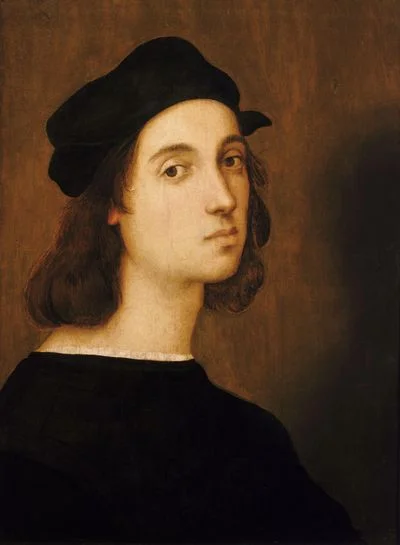
School of Athens. Madonna. Perfect harmony in paint. Died young, left perfection.
Conversation Starters
Life Journey
Raffaello Sanzio da Urbino was born to Giovanni Santi, a painter at the court of the Duke of Urbino. Growing up in this cultured environment, he was exposed to the arts from his earliest years.
Raphael's mother, Magia di Battista Ciarla, died when he was only eight years old. This early loss would be followed by his father's death just three years later, leaving young Raphael an orphan.
Giovanni Santi died, leaving his eleven-year-old son his painting workshop and materials. Despite his young age, Raphael showed remarkable artistic ability that would soon attract the attention of master painters.
Raphael began his formal apprenticeship under Pietro Perugino, one of the leading painters of the era. Under Perugino's guidance, he mastered the graceful, harmonious style that would characterize his early works.
At just seventeen, Raphael was already being called a master painter rather than an apprentice. He received his first major independent commission, demonstrating skills that rivaled his teacher.
Raphael completed The Marriage of the Virgin, a masterpiece that surpassed his teacher Perugino's version of the same subject. This work announced his arrival as one of Italy's premier artists.
Raphael relocated to Florence, the epicenter of Renaissance art. Here he studied the works of Leonardo da Vinci and Michelangelo, absorbing their innovations while developing his own distinctive style.
During his Florentine period, Raphael produced a series of celebrated Madonna paintings, including La Belle Jardinière and Madonna of the Goldfinch. These works established his reputation for ideal beauty and graceful composition.
Pope Julius II called Raphael to Rome to work on decorating the Vatican Palace. This papal commission would lead to the creation of some of the most celebrated frescoes in Western art history.
Raphael began work on the Stanza della Segnatura, the Pope's private library. His frescoes, including The School of Athens, would become defining works of High Renaissance art.
Raphael completed The School of Athens, his masterpiece depicting ancient Greek philosophers gathered in an idealized architectural setting. This fresco represents the pinnacle of Renaissance humanist ideals.
Raphael continued decorating additional rooms in the Vatican, including the Stanza di Eliodoro with its dramatic religious scenes. His workshop grew to handle the enormous scale of papal commissions.
Following Bramante's death, Raphael was appointed chief architect of St. Peter's Basilica. He also became Commissioner of Antiquities, tasked with preserving Rome's ancient monuments.
Raphael designed cartoons for tapestries to hang in the Sistine Chapel, depicting scenes from the lives of Saints Peter and Paul. These designs demonstrated his mastery of monumental narrative composition.
Raphael began work on The Transfiguration, commissioned for the Narbonne Cathedral. This ambitious painting would become his final masterpiece, left unfinished at his death.
Raphael became engaged to Maria Bibbiena, niece of Cardinal Bibbiena. However, he continually postponed the marriage while maintaining a relationship with his beloved model, La Fornarina.
Raphael died on Good Friday, April 6, 1520, reportedly his 37th birthday, possibly from exhaustion and fever. Rome mourned deeply; he was buried in the Pantheon, and his unfinished Transfiguration hung at his funeral.