Quick Facts
A quiet, steadfast seamstress whose defiance on a bus ignited mass protest and reshaped American civil rights.
Conversation Starters
Life Journey
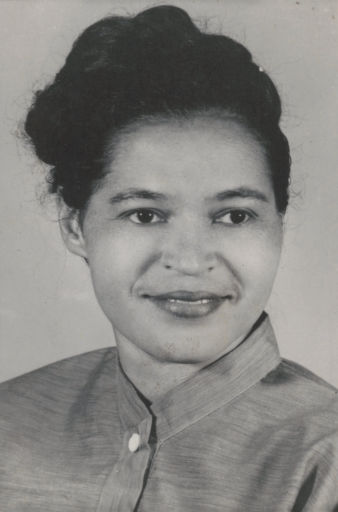
Rosa Louise McCauley was born in Tuskegee, Alabama, during the height of Jim Crow segregation. Her parents, Leona Edwards and James McCauley, raised her amid constant racial intimidation and limited schooling opportunities.
After her parents separated, she lived with her mother and grandparents in Pine Level, Alabama. She walked to school and witnessed Ku Klux Klan threats, experiences that hardened her sense of dignity and personal safety.
She studied at the Montgomery Industrial School for Girls, founded by northern progressive educators and supported by Black communities. The school emphasized academic rigor, self-respect, and civic responsibility under segregation.
In Montgomery, she met Raymond Parks, a barber active in efforts to defend the Scottsboro Boys. His organizing and political conversations introduced her to the discipline of movement work beyond personal protest.
Rosa married Raymond Parks and joined a circle of Black Montgomerians discussing voting rights and anti-lynching campaigns. She worked as a seamstress and domestic worker, balancing economic pressures with growing civic engagement.
Encouraged by Raymond, she returned to education and earned a high school diploma, unusual for Black women in Alabama at the time. The achievement strengthened her confidence and prepared her for administrative movement roles.
She joined the NAACP Montgomery chapter and served as secretary under president E. D. Nixon. In this role she documented racial violence, recorded complaints, and supported investigations that white authorities often ignored.
She assisted efforts demanding justice for Recy Taylor, a Black woman abducted and raped by white men in Abbeville, Alabama. Parks helped gather testimony and mobilize networks, exposing systemic impunity in Southern courts.
Parks advised the NAACP Youth Council in Montgomery, mentoring teenagers in disciplined activism and community service. She encouraged young people like Claudette Colvin to see themselves as citizens entitled to equal treatment.
In summer 1955, she attended workshops at Highlander Folk School, a Tennessee center for labor and civil rights education. The training reinforced nonviolent organizing and connected her to a wider network of movement thinkers.
On December 1, 1955, she refused a driver’s order to give up her seat to a white passenger on a Montgomery city bus. Police arrested her under segregation ordinances, and local activists quickly organized around her case.
Jo Ann Robinson and the Women’s Political Council circulated flyers calling for a one-day boycott that expanded into a mass campaign. Parks became a dignified symbol as the Montgomery Improvement Association formed under Martin Luther King Jr.
The federal case Browder v. Gayle ruled bus segregation unconstitutional, and the Supreme Court affirmed the decision in 1956. After 381 days of boycott, Montgomery buses were desegregated, marking a national turning point.
After sustained harassment and difficulty finding work in Alabama, Rosa and Raymond Parks moved north to rebuild their lives. In Detroit, she continued activism while confronting housing discrimination and de facto segregation in the urban North.
She joined the staff of U.S. Representative John Conyers Jr., a Detroit congressman aligned with civil rights and labor causes. Parks handled constituent service and remained a trusted moral voice in local and national political battles.
With Elaine Eason Steele, she co-founded the Rosa and Raymond Parks Institute for Self Development to educate youth in civil rights history. The institute’s “Pathways to Freedom” program connected students to historic movement sites and lessons.
President Bill Clinton awarded her the Presidential Medal of Freedom, the highest U.S. civilian honor. The ceremony recognized decades of sustained activism, not only the 1955 arrest that made her a global symbol.
The U.S. Congress honored her with the Congressional Gold Medal, celebrating her role in advancing constitutional equality. The bipartisan tribute reflected her enduring influence on American civic identity and protest traditions.
Rosa Parks died in Detroit, Michigan, after years of national recognition and continued public advocacy. She became the first woman to lie in honor in the U.S. Capitol Rotunda, with memorials spanning Montgomery and Washington.