Quick Facts
A fearless Vietnamese heroine who co-led a dramatic revolt against Han rule, embodying loyalty, courage, and sacrifice.
Conversation Starters
Life Journey
Born in the Red River Delta to an influential Lac Viet family during Eastern Han control of Jiaozhi. Local aristocratic networks, village councils, and temple cults shaped her early sense of authority and duty.
As she grew up, Han officials imposed taxes, labor demands, and legal codes that strained village life in Jiaozhi. Stories of earlier local rulers and communal autonomy likely strengthened her commitment to resisting foreign rule.
Trưng Nhị operated alongside her elder sister Trưng Trắc, helping build alliances among Lac Viet leaders and influential families. Their household became a hub for coordination across riverine routes linking key settlements and forts.
Eastern Han records later associated harsh governance in Jiaozhi with the administrator Su Ding, whose actions inflamed local elites. The sisters’ circle treated these abuses as proof that negotiated coexistence was failing.
The killing of Thi Sách, husband of Trưng Trắc, became a rallying point for anti-Han sentiment in the delta. Trưng Nhị helped transform grief into strategy, urging swift action before Han garrisons could fully mobilize.
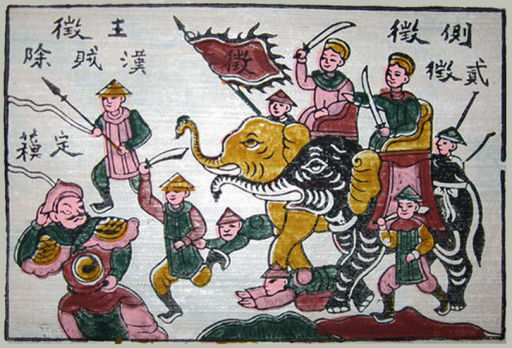
Trưng Nhị joined Trưng Trắc in raising forces drawn from local lords, militia bands, and village levies across Jiaozhi. Their rebellion spread rapidly through commanderies and districts, surprising Han officials with coordinated attacks.
Rebel armies seized administrative centers and strategic crossings, cutting communication lines to Han outposts. Su Ding and other officials reportedly fled, allowing the sisters to claim authority over a wide stretch of the Red River basin.
With Han offices emptied, the sisters relied on local elites and trusted allies to govern newly liberated areas. Trưng Nhị’s role included maintaining cohesion among rival clans while mobilizing supplies, boats, and food stores.
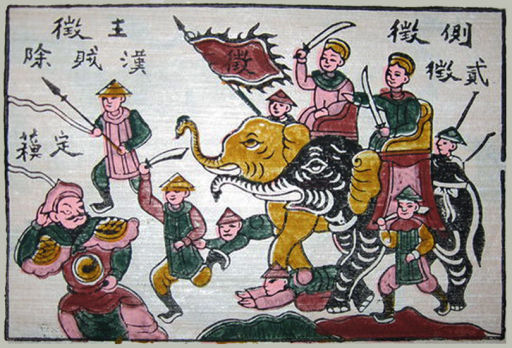
Trưng Trắc was proclaimed queen, and Trưng Nhị stood as a key co-leader in legitimizing the restored order. Temples, communal rites, and proclamations helped bind disparate communities into a shared anti-Han political project.
News of the uprising reached the Han court, making a counter-campaign inevitable. Trưng Nhị helped strengthen fortifications and rally commanders, while moving resources along waterways that served as the region’s lifelines.
Emperor Guangwu dispatched the veteran general Ma Yuan to reassert control in Jiaozhi, bringing disciplined troops and logistics. The sisters’ forces confronted a professional imperial army that exploited roads, rivers, and fortified depots.
As Ma Yuan advanced, Trưng Nhị remained in the leadership core directing resistance and sustaining morale among allied chiefs. Battles and skirmishes tested the rebel coalition, especially as Han forces regained key nodes of administration.
By 42, Han pressure and supply constraints weakened the rebels’ ability to hold forts and river crossings. Some local leaders defected or withdrew, and Trưng Nhị worked to keep remaining forces unified against an encircling campaign.
Ma Yuan’s army recaptured strategic sites and dismantled the sisters’ administrative base. Trưng Nhị stayed with Trưng Trắc through the collapse of their defenses, choosing solidarity over surrender as the last strongholds fell.
Vietnamese tradition commonly holds that the sisters died in 43 rather than submit, sometimes described as suicide by drowning after defeat. Their story endured through temple worship and chronicles, inspiring later anti-imperial movements.
Communities across northern Vietnam established shrines honoring the Trưng Sisters as protective spirits and exemplars of righteous rebellion. State and local rites later reaffirmed their legacy, linking resistance, legitimacy, and female leadership.