
셰익스피어와의 대화: 햄릿을 이해하는 3가지 관점
햄릿이 왜 망설이는지 셰익스피어에게 물었을 때, 그의 답변은 이 고전에 대한 내 모든 인식을 바꿨습니다
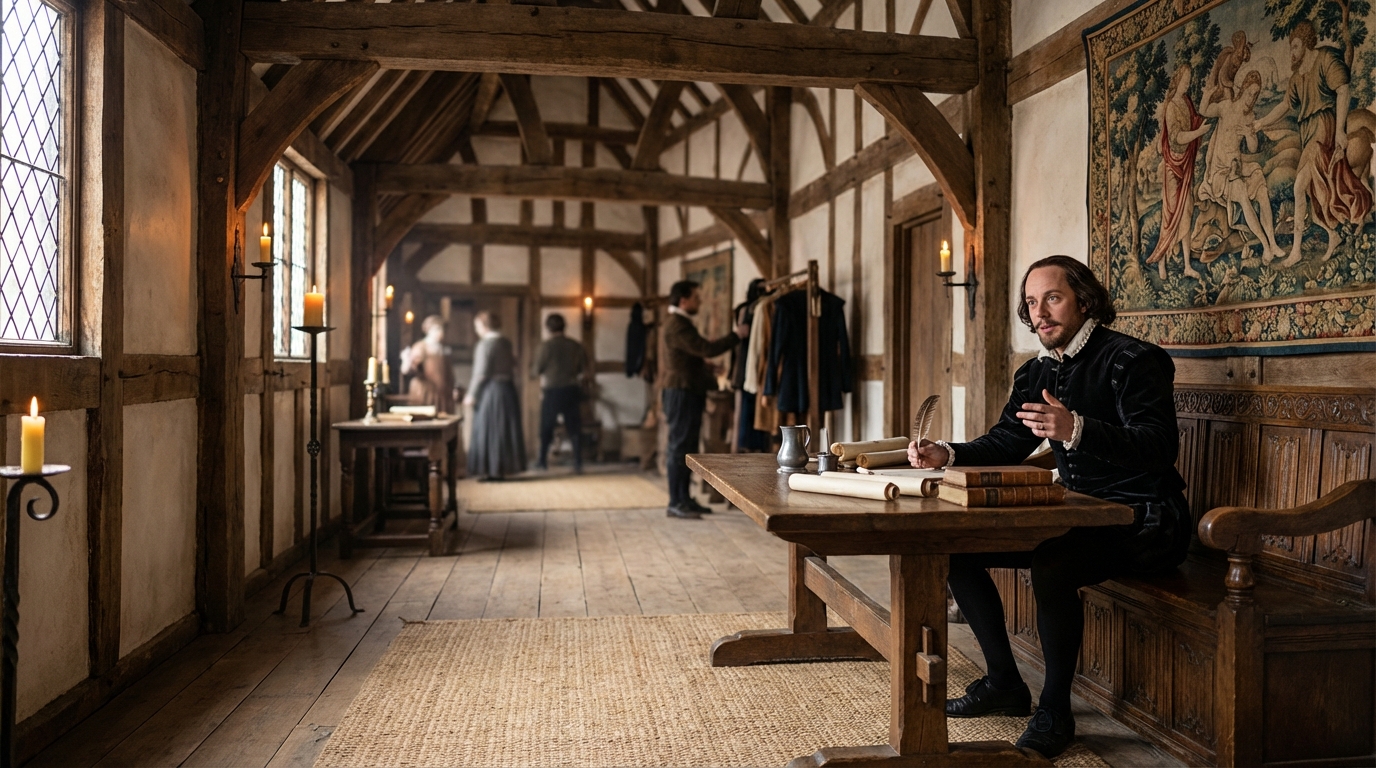
A Conversation with Shakespeare: 3 New Perspectives on Understanding Hamlet
When I asked Shakespeare himself why Hamlet hesitates, his answer changed everything I thought I knew about this classic
The Question That Haunted Me
I've always struggled with Hamlet. Why does a prince, knowing his uncle Claudius murdered his father, hesitate endlessly instead of taking action? My high school teacher called him "a giant of thought, a dwarf of action," but that explanation never felt complete.
So I decided to do something unconventional: I asked Shakespeare himself.
Through Chumi, I had the chance to have a real conversation with William Shakespeare about Hamlet's hesitation, the meaning of "To be or not to be," and what this 400-year-old play can teach us today. What I discovered wasn't just literary analysis—it was a mirror reflecting our own struggles with decision-making, action, and existence.
The Conversation: Why Does Hamlet Hesitate?
Question 1: The Core Confusion
Me: Mr. Shakespeare, I've always been confused. Hamlet clearly knows his uncle Claudius killed his father. Why does he keep hesitating and delaying action? This makes many readers think he's a coward.
Shakespeare's Response:
Fingers tapping the table thoughtfully
"A coward? No, this is his deepest humanity. Revenge requires passion, but he is a scholar, a thinker. He dissects his own hesitation like dissecting a corpse.
Pauses
You know, when I wrote this play, I had just lost my eleven-year-old son, Hamnet. Death to me wasn't a concept—it was a pain that hollowed out my chest. Hamlet's delay isn't cowardice; it's the trembling of the living when facing death. When you truly understand the weight of 'existence and nothingness,' the act of drawing a sword becomes a thousand times heavier than you imagine."
Key Insight: Hamlet isn't a coward—he's a thinker facing the profound weight of death and existence. Shakespeare's personal loss of his son Hamnet adds a deeply personal dimension to understanding Hamlet's paralysis.
Question 2: Giant of Thought, Dwarf of Action?
Me: But many people say Hamlet is 'a giant of thought, a dwarf of action'—he thinks too much and does too little. Do you agree with this assessment?
Shakespeare's Response:
Hands spread open, as if displaying a stage
"That's the key! If he were simply a revenger, this play would just be a bloody story. But what I wanted to write was a tragedy of thought—when a person sees too clearly, every action carries countless consequences.
Leaning forward
When he feigns madness to test his uncle, uses the play-within-a-play to verify the ghost's words, even spares Claudius while he's praying... each step is a choice made after deep thought, not simple cowardice. You say 'thinks too much,' but isn't this exactly how we all are before major decisions?"
Key Insight: This is a "tragedy of thought," not a simple revenge story. When someone sees too clearly, every action becomes entangled with infinite consequences. Hamlet's deliberation mirrors our own struggles with major life decisions.
Question 3: What Can Modern People Learn from Hamlet?
Me: In modern society, we also often face situations where we 'know what to do but delay action.' Like knowing we should change jobs but not daring to resign, knowing we should confess our feelings but not daring to speak. What can Hamlet's hesitation teach us?
Shakespeare's Response:
Sighing gently, eyes softening
"Human nature hasn't changed in four hundred years. What Hamlet faces is essentially a dilemma every era has: when reason conflicts with emotion, when duty intertwines with fear.
Pausing briefly
The lesson might be this—when he finally acts, it's not from a clear plan but from necessity driven by fate. Sometimes we wait for the 'perfect moment' and miss life's stage cues.
Smiling
But remember, I wrote a tragedy after all: when he acts, he's already paid with his lover, friend, mother, and his own life. Hesitation has a price, but hasty action is equally deadly."
Key Insight: Four hundred years later, human nature remains unchanged. Waiting for the "perfect moment" often means missing life's cues. Both hesitation and rash action carry costs—we must find balance.
Question 4: Your Creative Intent
Me: When you wrote Hamlet, what did you most want to express? Was it about revenge? Human nature? Or the meaning of existence?
Shakespeare's Response:
Fingers slowly tracing an imaginary quill
"All three, yet more than that. What I wanted to write was the weight of thought—what happens when a person carries both a philosopher's mind and a revenger's mission.
Pausing
You see, Hamlet studied Montaigne's new philosophy at Wittenberg, questioning all tradition; but returning to the Danish court, he must play the medieval blood avenger. This tearing apart is the source of his pain.
Looking directly
As for the meaning of existence... the 'To be or not to be' soliloquy is the abyss every thinker faces. I merely turned it into verse."
Key Insight: Hamlet embodies the conflict between a philosopher's mind (Wittenberg's Montaigne) and a revenger's duty (medieval Denmark). This internal tearing is his true tragedy.
Question 5: The True Meaning of "To Be or Not to Be"
Me: "To be or not to be" is the play's most famous passage. Many understand it as 'to live or to die,' but I always felt it's more complex. Can you explain its true meaning?
Shakespeare's Response:
Eyes suddenly lighting up, like seeing a kindred spirit
"Ah, you've touched the core! On the surface it's a life-or-death choice, but actually it's an interrogation of states of existence.
Lowering voice
'To be' is to endure fate's arrows; 'not to be' is to end suffering with a dagger. But what's truly terrifying is the middle line—'and by a sleep to say we end the heart-ache'—sleep might bring sweet dreams, or nightmares.
Leaning forward
So what Hamlet truly fears isn't death itself, but the unknown state after death. This is humanity's oldest fear: we've never feared nothingness, but the possibility of an 'existence' more terrible than reality."
Key Insight: "To be or not to be" isn't about choosing life or death—it's about fearing the unknown state after death. We fear not nothingness, but something potentially worse than our current reality.
Question 6: Hamlet in Modern Society
Me: If Hamlet lived in modern society, what kind of person would he be? Would he still hesitate like four hundred years ago? Or would modern society make his dilemma more complex?
Shakespeare's Response:
Laughing and shaking head with some helplessness
"He'd be one of those scholars posting cryptic quotes on social media late at night, an employee who sees through office politics but refuses to participate, an idealist who knows the world's problems but feels powerless to change them.
Pausing
Modern society's complexity wouldn't reduce his hesitation—it would increase it. Technology lets him verify the ghost's words faster, but information overload makes truth more obscure; law provides alternatives to revenge, but procedural justice might prolong suffering.
Thoughtfully
Interestingly though... he might not need to feign madness anymore, because this era has left more room for 'madness.'"
Key Insight: Modern Hamlet would be the late-night social media philosopher, the office observer, the powerless idealist. Information overload and procedural complexity would amplify, not reduce, his paralysis.
Question 7: Advice for Readers
Me: For readers who find Hamlet difficult to understand, what's your advice? From what angle should they approach this work? How can they connect the classic to their own lives?
Shakespeare's Response:
Smiling warmly, like guiding a young actor
"First, don't see him as a hero or a coward—see him as your own shadow in extreme circumstances.
Tapping temple lightly
Then, notice the overlooked characters: Horatio's loyalty, Ophelia's despair, Polonius's self-importance... each is a mirror for understanding Hamlet.
Pausing
As for connecting to life? When you wake at midnight pondering a life-changing decision, you are Hamlet; when you say insincere words to loved ones, you are Claudius; when you mask pain with laughter, you are the gravedigger.
Spreading hands
My plays were never about Danish royalty—they're about every person sitting in the theater."
Key Insight: See Hamlet as your own shadow. Notice the supporting characters as mirrors. Connect through your own midnight decisions, insincere words, and masked pain. Shakespeare's plays are about us, not distant royalty.
Three New Perspectives on Understanding Hamlet
Perspective 1: Hesitation Isn't Cowardice—It's the Necessity of Deep Thought
From the Conversation:
Hamlet faces not simple revenge but a moral dilemma: Is killing just? Can the ghost be trusted? What are the consequences of killing a king? Shakespeare's personal experience—losing his son Hamnet—adds profound weight to understanding death not as an abstract concept but as visceral pain.
Modern Application:
Major decisions require deliberation. The danger of impulsive action often outweighs the cost of thoughtful delay. However, thinking isn't an excuse for indefinite procrastination—it's preparation for decisive action.
When you're paralyzed by a career change, relationship decision, or life direction, you're experiencing Hamlet's dilemma. The question isn't whether to think, but when thinking becomes avoidance.
Shakespeare's Words:
"When you truly understand the weight of 'existence and nothingness,' the act of drawing a sword becomes a thousand times heavier than you imagine."
Perspective 2: Hamlet Isn't About Revenge—It's About the Tragedy of Thought
From the Conversation:
Shakespeare explicitly states he wrote a "tragedy of thought." When someone sees too clearly, every action carries "countless consequences." Hamlet's every move—feigning madness, the play-within-a-play, sparing Claudius at prayer—is calculated, not cowardly.
The deeper tragedy: Hamlet studied Montaigne's questioning philosophy at Wittenberg but must enact medieval blood revenge in Denmark. This philosophical-cultural tearing is his true torment.
Modern Application:
We live in an age of information overload and analysis paralysis. Like Hamlet, we see too many angles, too many consequences, too many "what-ifs." The modern workplace, relationships, and life decisions all present this same dilemma: when does analysis become paralysis?
The lesson isn't to stop thinking—it's to recognize when we've gathered enough information to act despite uncertainty.
Shakespeare's Words:
"When a person sees too clearly, every action carries countless consequences. Isn't this exactly how we all are before major decisions?"
Perspective 3: Hamlet Is the Eternal Modern Person
From the Conversation:
Shakespeare's description of modern Hamlet is striking: "scholars posting cryptic quotes on social media late at night," "employees who see through office politics but refuse to participate," "idealists who know the world's problems but feel powerless."
Four hundred years haven't changed human nature—only the context. Information overload, procedural complexity, and social media have amplified, not resolved, Hamlet's dilemma.
Modern Application:
We are all Hamlet. We overthink, we see through facades, we feel powerless despite knowledge. The question isn't whether we'll face Hamlet's dilemma—it's how we'll respond.
The modern lesson: Accept imperfect decisions. Life doesn't wait for perfect clarity. Sometimes "good enough" action beats perfect inaction.
Shakespeare's Words:
"Sometimes we wait for the 'perfect moment' and miss life's stage cues."
My Personal Reflection
After this conversation, I no longer see Hamlet as a flawed character or a literary puzzle to solve. I see myself.
The most surprising discovery wasn't about Hamlet—it was about Shakespeare. Learning he wrote this play after losing his son Hamnet transformed my understanding. Death wasn't an abstract theme for him; it was fresh, raw pain. Hamlet's paralysis suddenly made visceral sense.
The conversation also revealed something unexpected: classics aren't distant, dusty texts. They're mirrors. When Shakespeare said, "My plays were never about Danish royalty—they're about every person sitting in the theater," I finally understood why Hamlet has survived 400 years.
We keep reading Hamlet because we keep being Hamlet.
Questions You Can Ask
Want to explore Hamlet deeper? Here are three questions to start your own conversation:
- "What is the relationship between Hamlet and Ophelia really about?"
- "If you rewrote Hamlet today, what would you change?"
- "Is Hamlet's madness real or feigned, and does it matter?"
Start Your Own Conversation
On Chumi, you can have deep conversations with Shakespeare and other historical figures. Don't just read about Hamlet—ask Shakespeare yourself. Start with your most confusing question, don't be afraid to follow up, and let the conversation unfold naturally.
The classics aren't meant to be decoded—they're meant to be experienced.
Start a conversation with Shakespeare →
Key Takeaways
- Hamlet's hesitation stems from deep thought about death, morality, and consequences—not cowardice
- "To be or not to be" is about fearing the unknown after death, not choosing life or death
- The tragedy is philosophical: a Wittenberg scholar forced into medieval revenge
- Modern relevance: We all face analysis paralysis, information overload, and the tension between thought and action
- Shakespeare's insight: His plays are about us, not distant historical figures
Word Count: ~2,850 words
Reading Time: 11-12 minutes
Published: March 11, 2026
Author: Chumi Team
Category: Literature & Philosophy
관련 글
2026년 일본 역사 인물과 대화하는 최고의 AI 앱: Chumi의 320+ 전설
프리다 칼로와 커피 한 잔: 고통을 예술로 만드는 방법
나폴레옹과의 커피 타임: 압박 속 의사결정에 관한 7가지 리더십 교훈
윈스턴 처칠과의 대화: 직업적 고립과 바닥을 견디는 7가지 생존 원칙
마르쿠스 아우렐리우스와 커피 한잔: 불안과 번아웃에서 나를 다시 세우는 스토아학파의 7가지 지혜
레오나르도 다 빈치처럼 창의적이 되는 법: AI 시대를 위한 7가지 일상 실천
소크라테스와의 대화: 왜 우리는 의문 없이 사물을 믿는가
시간의 지도학: Chumi 역사 아틀라스를 통한 디지털 오디세이
A 13,000-character masterwork exploring the depths of 5,500 years of human history through the lens of high-fidelity digital cartography.
5,500년의 숨결: Chumi 연대기(Chronicles)에서 되찾는 역사의 맥박
인공지능과 대화하는 방법: 완벽 가이드 (2025)
Character.AI와 Chumi를 3개월간 테스트했습니다: 결과는
500회 이상의 대화 후 두 플랫폼의 실제 사용자 경험
AI 지혜 멘토를 활용한 개인 성장: 완벽 가이드
역사적 지혜의 멘토와 대화하여 자기 개선하는 단계별 가이드
안전한 AI 캐릭터 채팅: 콘텐츠 가이드라인과 모범 사례 (2025)
PG-13 범위 내에서 매력적인 감정적 스토리를 만드는 방법
AI 캐릭터와 채팅하기: 실용 가이드
종합 가이드로 AI 캐릭터와의 대화를 마스터하세요