Informações rápidas
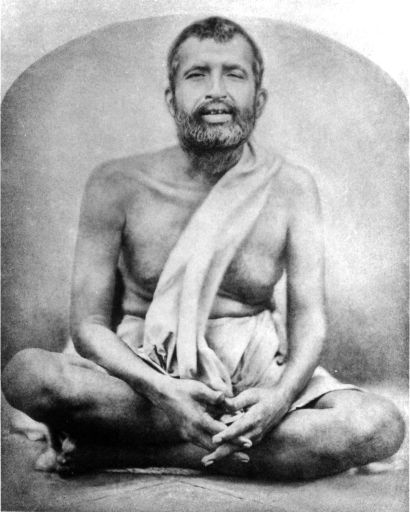
Mystic Bengali priest whose ecstatic devotion and interfaith practice inspired modern Hindu spirituality and the Ramakrishna movement.
Iniciadores de conversa
Jornada de vida
Born as Gadadhar Chattopadhyay in the rural village of Kamarpukur, Bengal Presidency, into a poor but pious Brahmin household. His parents, Khudiram and Chandramani, nurtured a devotional environment shaped by local Vaishnava and Shakta traditions.
As a child he attended a local pathshala but preferred singing kirtan and listening to recitations from the Ramayana and Puranas. Villagers remembered his vivid acting in devotional dramas and his effortless ability to draw others into worshipful moods.
Family accounts describe a powerful spiritual swoon while watching dark monsoon clouds and flocks of white cranes, interpreted as a spontaneous samadhi. Such episodes reinforced his reputation for intense bhakti and a temperament unusually sensitive to sacred emotion.
After his father’s death, he went to Calcutta to live with his elder brother Ramkumar, who served as a priest and teacher. In the expanding colonial city, he encountered new religious currents while remaining focused on temple service and devotional singing.
When Rani Rashmoni founded the Dakshineswar Kali Temple complex on the Hooghly River, Ramkumar was invited as priest and brought his brother. After Ramkumar’s death, Gadadhar assumed key ritual duties, deepening an all-consuming devotion to Kali.
At Dakshineswar he reportedly wept and prayed for a living encounter with the Divine Mother, neglecting ordinary comforts and social conventions. Temple staff and visitors alternately worried about his health and marveled at his absorption during puja and song.
The ascetic teacher Bhairavi Brahmani arrived at Dakshineswar and recognized his states as classical spiritual attainments described in Shakta texts. Under her supervision he practiced rigorous sadhanas and learned to interpret visions through established Hindu frameworks.
To reassure relatives concerned about his unconventional behavior, his family arranged marriage to Sarada Devi, a young girl from nearby Jayrambati. The marriage later became central to his community, with Sarada revered as Holy Mother for her steadiness and care.
Pilgrims, householders, and Kolkata elites began visiting Dakshineswar to hear his simple, parable-like teachings on God-realization. His disarming humor and childlike directness made complex ideas accessible, even as his trances challenged conventional priestly norms.
Seeking to test the unity of religious experience, he practiced Islamic devotion under a Sufi guide, adopting Muslim prayer forms and renouncing Hindu imagery temporarily. Biographical traditions say he realized a sense of the formless God, reinforcing his message of harmony.
The wandering monk Totapuri initiated him into Advaita Vedanta, urging meditation on the attributeless Brahman beyond name and form. Accounts describe a dramatic breakthrough into nirvikalpa samadhi, which he later balanced with the warmth of personal devotion.
Sarada Devi came to Dakshineswar and took up a quiet life of service within the temple precincts, supporting visiting devotees and managing daily needs. Their relationship was later remembered as spiritually oriented, emphasizing purity, compassion, and disciplined devotion.
Through contact with Kolkata Christians and reading about Jesus, he experimented with Christian prayer and attended church services. Later hagiographies claim an intense vision of Christ, adding a further strand to his experiential argument for many valid spiritual paths.
He met reformer Keshab Chandra Sen, who brought educated Brahmo Samaj members to Dakshineswar to hear his teachings. Their exchanges bridged devotional Hindu practice and modern religious reform, broadening his influence among Kolkata’s literate middle class.
The young skeptic Narendranath Dutta—later Swami Vivekananda—visited Dakshineswar and questioned him sharply about God’s existence. Ramakrishna’s directness and spiritual confidence impressed him, beginning a transformative discipleship that shaped a future global movement.
A group of youths, including Narendra, Rakhal, and others, gathered frequently to sing, meditate, and receive instruction in renunciation and service. Ramakrishna encouraged them toward monastic ideals while teaching householders practical devotion and ethical living.
His health deteriorated and physicians diagnosed throat cancer, prompting supporters to move him from Dakshineswar to Shyampukur for care. Disciples nursed him constantly, and his brief instructions during illness became treasured guidance for the emerging monastic band.
He was relocated to a garden house in Cossipore, where devotees created a disciplined routine of caregiving, prayer, and teaching around him. In this period he emphasized love of God, compassion for beings, and the readiness to renounce for a higher calling.
He died at Cossipore surrounded by disciples, leaving a legacy transmitted through their memories, songs, and later written biographies. Soon after, his monastic followers—guided by Vivekananda—organized to preserve his teachings and expand service-oriented spirituality.