Quick Facts
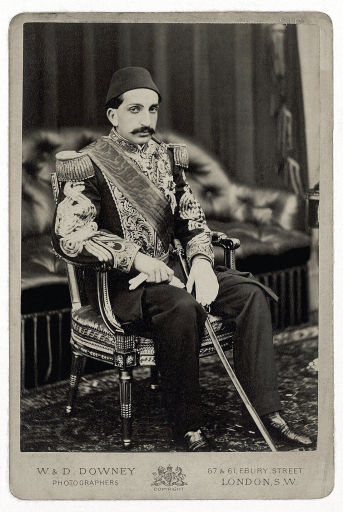
An autocratic yet reform-minded Ottoman sultan who wielded pan-Islamic diplomacy, surveillance, and modernization amid imperial decline.
Conversation Starters
Life Journey
Born as Abdulhamid in the Topkapi Palace milieu during the Tanzimat era, he was the son of Sultan Abdülmecid I. Raised in an imperial court balancing reform and tradition, he absorbed politics amid mounting European pressure.
He studied Ottoman Turkish, Arabic, Persian, and religious texts under palace tutors while observing court etiquette and statecraft. Exposure to bureaucrats shaped his belief that information control and discipline were essential to survival.
After Sultan Abdülmecid I died, Abdülaziz took the throne and intensified military and infrastructure spending. Abdul Hamid watched elite rivalries, debt, and factional politics harden, lessons that later informed his suspicion of coups.
He joined the imperial tour to Paris and London, seeing Napoleon III's France and Victorian Britain at the height of power. The trip highlighted Western technology and administration, but also the diplomatic leverage Europe held over Ottoman finances.
Following the deposition of Abdülaziz and the brief reign of Murad V, he became sultan amid turmoil and reformist pressure. Statesmen like Midhat Pasha sought constitutional limits, while foreign creditors and rival powers demanded concessions.
He approved the Kanun-i Esasi and opened a parliament to signal reform and deflect European intervention over Balkan unrest. The move placed the empire among constitutional monarchies in form, even as he retained broad emergency powers.
Russia declared war and Ottoman armies suffered major defeats, culminating in dire negotiations. The conflict exposed military weakness and administrative fragmentation, convincing him that centralized control and internal security were imperative.
After the war, he dissolved the parliament and suspended constitutional life, shifting governance to Yildiz Palace. He built a dense intelligence network and censorship regime, arguing that factionalism endangered the state's very existence.
The Congress of Berlin revised the Treaty of San Stefano, reducing Ottoman losses but accelerating Balkan autonomy and foreign oversight. He saw Great Power diplomacy decide Ottoman borders, and responded by emphasizing legitimacy as caliph to Muslims abroad.
The Ottoman Public Debt Administration (OPDA) was established to secure repayment to European bondholders after default. Though humiliating, it stabilized revenues and constrained fiscal sovereignty, pushing him to seek development within tight financial limits.
His government invested in new secondary schools, professional academies, and teacher training to staff a modernizing state. Graduates formed a larger educated public, including future Young Turks, even as the regime tried to channel their loyalties.
Unrest in Sasun led to harsh repression and international outcry as Armenian communities demanded reforms promised in earlier treaties. European consuls and journalists reported atrocities, and the palace treated revolutionary groups as existential threats.
Armenian revolutionaries seized the Ottoman Bank to force Great Power attention, prompting a tense standoff and diplomatic mediation. In the aftermath, violence and reprisals spread, deepening communal fear and hardening his security-first approach.
He promoted the Hejaz Railway to connect Damascus to Medina, strengthening pilgrimage routes and imperial cohesion. Funded partly by Muslim donations worldwide, the line embodied his pan-Islamic messaging and practical military-logistical goals.
Members of the Armenian Revolutionary Federation planted a bomb timed for his exit from Friday prayers near Yildiz Mosque. A delay spared him, but the blast killed and wounded many, reinforcing his reliance on policing and informants.
Officers tied to the Committee of Union and Progress (CUP) rose in Macedonia, demanding constitutional rule and an end to palace autocracy. Facing mutiny and international risks, he reinstated the 1876 constitution and reopened parliament.
A counterrevolutionary uprising in Istanbul triggered chaos, and the CUP's Action Army marched from Salonica to restore order. Parliament deposed him and installed Mehmed V, ending his reign and recasting him as a symbol of the old regime.
He was sent into confinement in Salonica, monitored by the new constitutional authorities and cut off from direct influence. The exile underscored the shift of power from palace politics to party and military networks driving imperial policy.
After Salonica fell to Greece in the First Balkan War, he was transferred back to Istanbul for security reasons. The empire's rapid territorial losses confirmed the collapse of the Balkan order he had struggled to manage through diplomacy and control.
He died in custody months before the Armistice of Mudros formalized Ottoman defeat and occupation pressures. His long reign was reassessed amid wartime catastrophe, with debates over modernization, repression, and the costs of survival politics.