Quick Facts
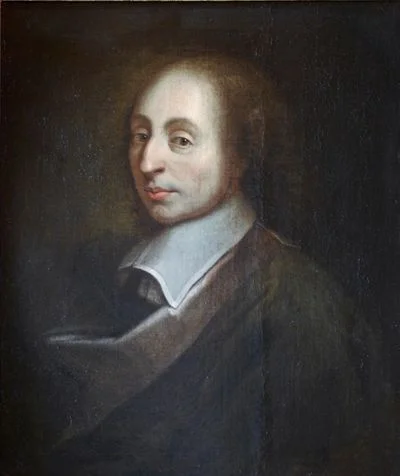
Pascal's wager. Pascaline calculator. Mathematical prodigy who found God in philosophy.
Conversation Starters
Life Journey
Blaise Pascal was born into a family of minor nobility. His father Étienne was a tax commissioner and talented mathematician who would later personally educate his children in an unconventional manner that encouraged independent thinking.
Pascal's mother Antoinette Begon died when he was just three years old. His father never remarried and devoted himself to raising Blaise and his two sisters, fostering an intellectually stimulating household.
The Pascal family relocated to Paris so that Étienne could better pursue his scientific interests. Young Blaise was exposed to the vibrant intellectual circles of the French capital, meeting leading mathematicians and scientists of the era.
Pascal started attending meetings of Marin Mersenne's academy, where Europe's leading mathematicians gathered to discuss the latest discoveries. Despite his young age, he impressed the scholars with his precocious mathematical abilities.
Pascal wrote his first major mathematical work, an essay on conic sections that introduced what is now known as Pascal's theorem. The work astounded mathematicians including Descartes, who initially refused to believe it was written by a teenager.
The Pascal family moved to Rouen when Étienne was appointed tax commissioner for Upper Normandy. Blaise observed his father's tedious calculations and began conceiving a mechanical calculator to ease such laborious work.
Pascal began developing the Pascaline, one of the first mechanical calculators. He spent three years perfecting the device, which could perform addition and subtraction automatically through an ingenious system of interlocking gears.
Pascal presented his completed calculator to the French chancellor and received a royal privilege protecting his invention. Though commercially unsuccessful due to its high cost, the Pascaline demonstrated the possibility of mechanical computation.
After his father injured his leg, Pascal encountered Jansenist physicians who introduced the family to this austere Catholic movement. This first conversion marked the beginning of Pascal's lifelong engagement with religious questions.
Pascal conducted groundbreaking experiments on atmospheric pressure, demonstrating that air has weight and that a vacuum can exist. His work confirmed Torricelli's theories and led to the invention of the syringe and hydraulic press.
Étienne Pascal died, leaving Blaise devastated. The loss intensified his religious contemplation, though he subsequently entered a period of worldly pursuits, socializing with libertine intellectuals in Paris.
Pascal exchanged letters with Pierre de Fermat about gambling problems, laying the foundation for probability theory. Their correspondence introduced concepts that would revolutionize mathematics, statistics, and decision theory.
On November 23, Pascal experienced an intense mystical vision that transformed his life. He recorded the experience on parchment sewn into his coat, describing it as 'Fire. God of Abraham, Isaac, and Jacob, not of philosophers.' He devoted himself entirely to religion afterward.
Pascal joined his sister Jacqueline at the Jansenist convent of Port-Royal. Though not formally a monk, he lived an ascetic life dedicated to prayer, study, and defending Jansenism against Jesuit attacks.
Pascal published the first of his Provincial Letters, a series of witty polemics defending Jansenism against Jesuit moral theology. The letters became a masterpiece of French prose and a landmark in the history of satire and religious controversy.
Despite declining health, Pascal returned briefly to mathematics, solving problems related to the cycloid curve. He challenged other mathematicians with these problems and published his solutions, demonstrating his continued brilliance.
Pascal began organizing notes for a great apology for the Christian religion. Though never completed, these fragments were published posthumously as the Pensées, containing his famous wager argument and profound reflections on faith and reason.
Blaise Pascal died at age 39, likely from stomach cancer compounded by his lifelong poor health. His unfinished Pensées and groundbreaking work in mathematics, physics, and philosophy secured his legacy as one of history's greatest minds.